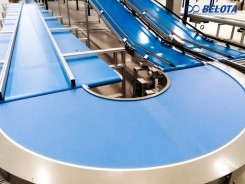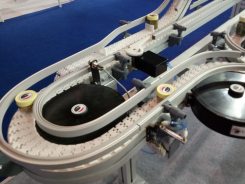
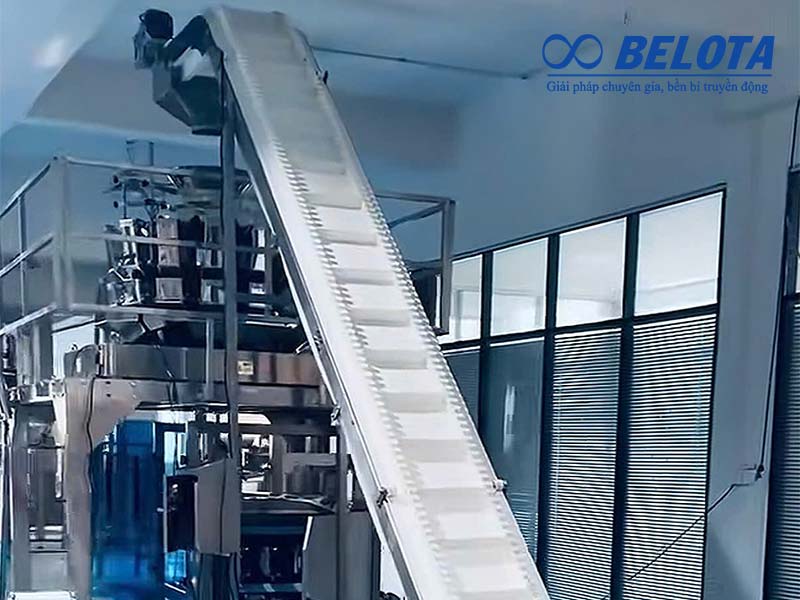
In many factories today, transporting goods between different elevations requires continuity, stability, and space efficiency. PVC corrugated conveyor belts are a widely used solution thanks to their flexible inclined or Z-shaped transport capability, easily integrated into various production lines.
Suitable for packaging, logistics, food, and electronics industries, helping reduce manual handling labor. Belota designs and manufactures PVC corrugated conveyor belts according to each factory's actual requirements, with no fixed templates, ensuring compatibility with specific spaces and goods.
Characteristics of PVC Corrugated Conveyor Belts
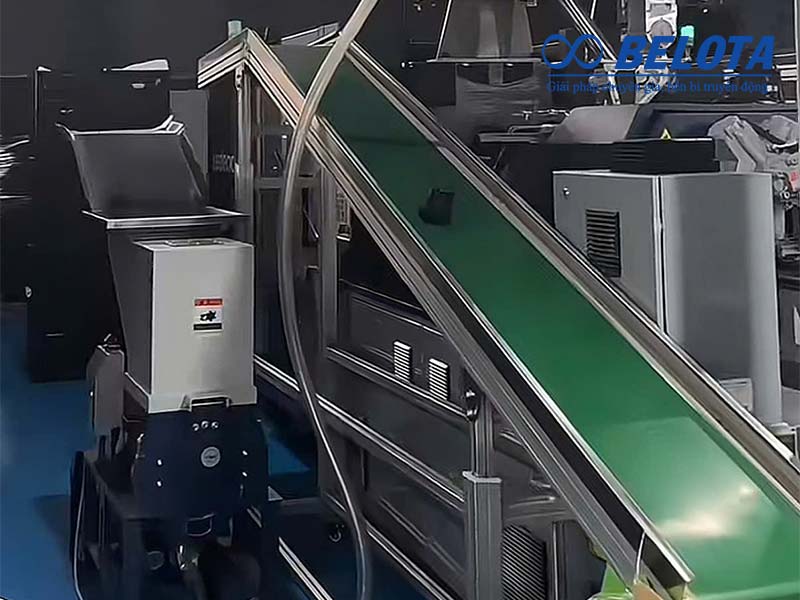
PVC corrugated conveyor belts are designed with multiple horizontal and inclined sections continuously linked, transporting goods between different elevations within the same system. Common layouts are Z-shaped or S-shaped, depending on floor space and operational requirements.
Compared to using multiple separate conveyors, corrugated belts optimize installation space, reduce transfer points, and maintain more continuous transport. Inclination angle and conveyor height can be customized according to workshop layout and product type.
Construction
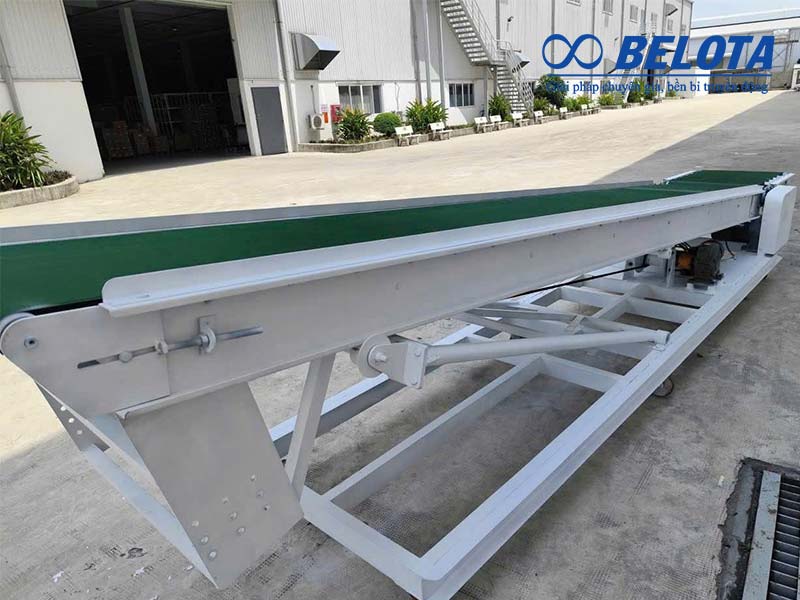
- Frame: Usually fabricated from powder-coated steel or stainless steel, ensuring rigidity at inclined sections and bending points.
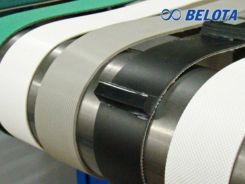
- PVC Belt: Typically green PVC belt, selected according to load capacity and product type. For inclined sections, T-cleats or side guards can be added to prevent product slipping.
- Drive System: Includes gear motor, drive pulley and driven pulley for stable operation. Some lines can integrate inverters for speed adjustment.
- Lifting Mechanism: Can use handwheels, screw shafts, or pneumatic cylinders to change height and inclination angle.
- Support Legs and Wheels: Adjustable legs for leveling on various floor types. Locking casters support movement and fixing when changing workshop layout.
Technical Specifications
| Parameter | Reference Value |
|---|---|
| Belt width | 300mm – 1,200mm (customizable) |
| Belt length | Designed per floor plan and actual needs |
| Belt material | Green PVC, thickness 2mm – 5mm |
| Operating inclination | Approx. 15° – 45° |
| Operating voltage | 220V or 380V |
| Belt speed | 5 – 30 m/min, adjustable |
| Standard load capacity | 20 – 200 kg/m |
| Frame material | Powder-coated steel or stainless steel |
| Additional options | T-cleats, side guards, casters, speed controller |
Operating Principle
The corrugated conveyor operates through a gear motor transmitting power to the drive pulley, moving the PVC belt continuously in a closed loop. Goods are placed at the feed point, then travel through the inclined section to the output at a different elevation within the same system.
For steep sections, T-cleats are integrated to prevent products from sliding back when conveying upward. For stable-surface goods at low inclination angles, smooth belt can be used to optimize costs.
Factors Affecting Operational Stability
- Belt tension: Too loose causes slipping; too tight increases load on motor and bearings
- Inclination angle: Steeper angles require T-cleats or side guards
- Actual load: Overloading reduces belt and motor lifespan
- Frame and pulley quality: Insufficient rigidity causes belt misalignment and vibration
Advantages and Applications
- Optimizes installation space
- Reduces manual handling labor
- Stable operation, easy maintenance
- Easy integration into production lines
- Practical applications: carton transport in packaging lines, warehouse logistics, packaged food industry, electronics components and industrial assembly.
Selection Guide
- Choose according to product load capacity
- Calculate appropriate inclination angle (smooth belt typically suitable below 30°)
- Choose correct belt thickness
- Prioritize design based on actual conditions
Belota's Custom Manufacturing Service
Belota provides PVC corrugated conveyor belt solutions designed and manufactured according to each enterprise's actual requirements, including installation support, operational guidance, and maintenance to maintain stable long-term performance.
FAQ
When should corrugated conveyors be used instead of straight conveyors?
Corrugated conveyors (Z or L-shaped) are optimal when transporting goods between different elevations in limited spaces, replacing multiple separate conveyors to reduce transfer points and save floor space.
What is the purpose of T-cleat PVC belts?
T-cleats are molded or heat-welded onto the belt surface to create resistance, keeping products stable when operating on inclined sections. Cleat height and spacing are designed specifically based on cargo size.
Is maintenance cost high?
PVC conveyors have relatively simple construction so maintenance costs are relatively low, mainly requiring periodic checks of belt tension, pulley surface cleaning, and lubrication of bearings and motors.
Conclusion
The equipment helps optimize installation space, reduce handling labor, and maintain stable operation across various production environments. Thanks to flexible customization according to load and floor plan, the system can be easily integrated into many modern industrial lines. If your enterprise needs a multi-elevation goods transport solution, Belota is ready to consult and manufacture PVC corrugated conveyor belts suited to your actual operational requirements.