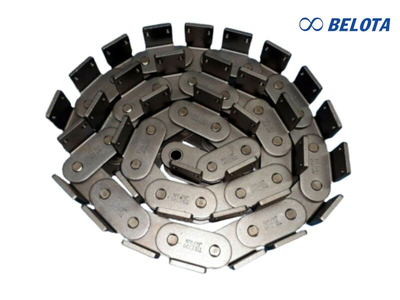
In mechanical production and automation systems, attachment chains act like “mechanical arms” that securely hold and transport materials with high precision. More than just a transmission component, these chains are specially designed to solve fixture and handling challenges for products with complex shapes that conventional flat conveyors cannot manage.
Let’s explore the structure, types, and applications of attachment chains with Belota.
What Is an Attachment Chain?
An attachment chain is a modified version of a standard roller chain integrated with special attachments such as A1, K1, SA1, SK1, and other custom fixtures. These attachments serve as mounting points that allow users to install guide bars, buckets, holders, or custom fixtures for gripping and positioning products during conveying or processing.
Unlike standard roller chains used only for power transmission, attachment chains provide maximum flexibility and can be customized for specific conveyor and automation applications.
Basic Technical Specifications
- Material: Carbon steel, stainless steel (SS304/316), nickel-plated steel, engineering plastic
- Operating temperature: From -10°C to 400°C depending on material and lubricant
- Load capacity: Reference working load up to 332.7 kg/m depending on chain model
Structure of an Attachment Chain
A complete attachment chain system consists of several key components:
- Conveyor Chain: Manufactured from high-strength alloy steel with galvanized or anti-rust coating to improve durability and corrosion resistance in harsh environments.
- Lever / Handle Mechanism: Transfers force from the operator to the chain system, ensuring flexible and convenient operation.
- Sprockets: Engage directly with the chain to ensure smooth and stable power transmission while minimizing wear.
- Hooks and Load Holders: Used for hanging equipment or securing loads during lifting and conveying operations.
- Clamping Fixtures: Help secure equipment to machine frames or working surfaces, ensuring operational stability.
Common Types of Attachment Chains
Standard Pitch Attachment Chains
- Based on ANSI chain standards such as 40, 50, 60, 80
- Short pitch with thick chain plates
- Suitable for high-load transmission and short-distance precision applications
Double Pitch Attachment Chains
- Based on C-Series chains such as C2040, C2050, C2060
- Pitch length is twice that of standard chains
- Lighter weight, quieter operation, and cost-effective for long conveyor systems with medium speeds
Common Attachment Types
Standard Attachments
A-Type Attachments
Bent 90-degree attachment mounted on one side of the chain.
- A1: single mounting hole
- A2: double mounting holes
K-Type Attachments
Bent attachments mounted on both sides of the chain.
- K1: single hole on each side
- K2: double holes on each side
SA-Type Attachments
Vertical attachment mounted on one side.
- SA1: single mounting hole
- SA2: double mounting holes
SK-Type Attachments
Vertical attachment mounted on both sides.
- SK1: single hole on each side
- SK2: double holes on each side
Special Attachments
- GNK1: attachment hole located directly on the chain plate
- EP (Extended Pin): extended pins for accessories or guides
- HP (Hollow Pin): hollow center chain pin design
- Custom Attachments: spike attachments, side rollers, and other custom fixture designs
Key Advantages of Attachment Chains
- Flexible and Versatile: Easy to install and customize for products with different shapes and sizes.
- High Durability: Made from strong alloy steel with excellent load capacity and corrosion resistance.
- Safe Operation: Secure structure helps stabilize products during movement and reduces the risk of falling materials.
- Industrial Applications: Attachment chains are widely used in many industries, including:
- Food industry: confectionery packaging lines, agricultural drying conveyors
- Assembly industry: electronics and automotive assembly systems
- Printing & packaging: paper guiding and carton conveying systems
- Lifting systems: freight elevators and bucket elevators
How to Choose a High-Quality Attachment Chain
When selecting an attachment chain, users should consider:
- Breaking load capacity suitable for conveyor and product weight
- Correct attachment style (single side, double side, single hole, double hole)
- Material selection based on working environment
- Dimensional precision for accurate fixture installation
- For food or chemical industries, stainless steel 304 chains are recommended for better corrosion resistance and hygiene.
Where to Buy Reliable Attachment Chains?
Optimizing your production line starts with selecting the right transmission components. With flexible custom manufacturing capabilities and durable products, Belota is committed to providing efficient attachment chain solutions for your business.
Contact Belota today via Hotline/Zalo 0917 657 946 for technical consultation and the best quotation for attachment chains.