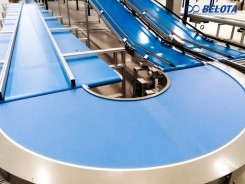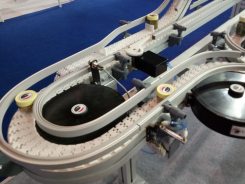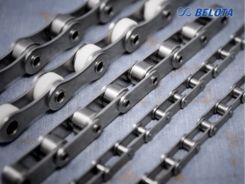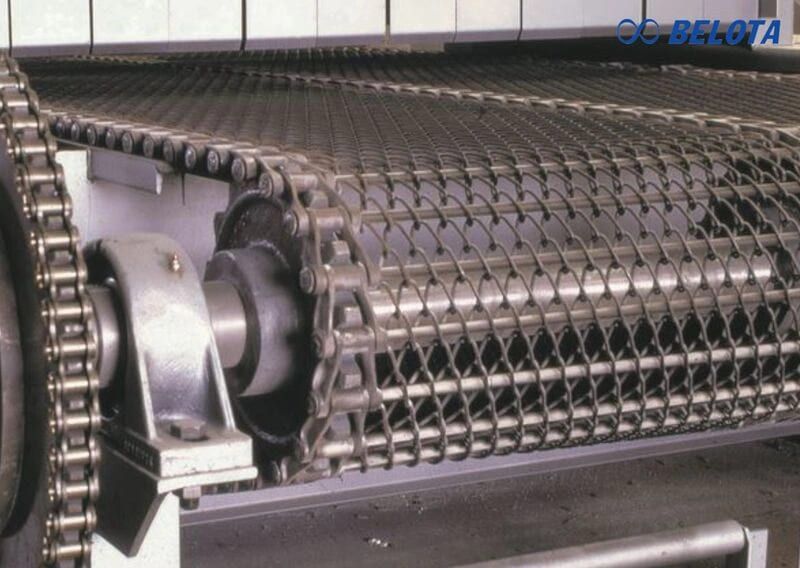
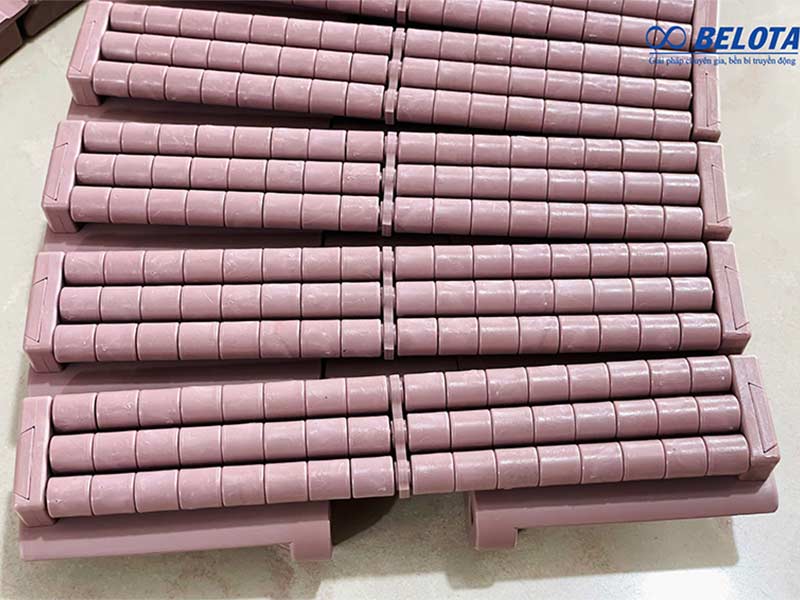
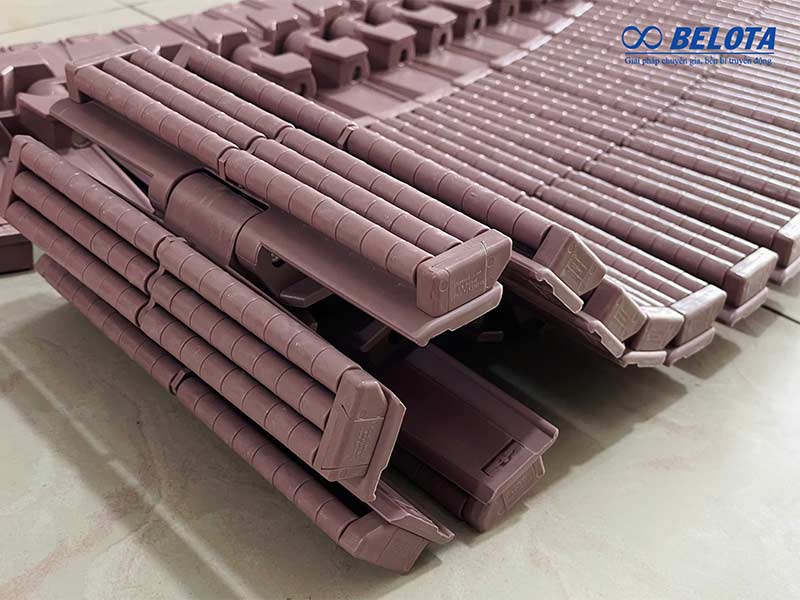
A plastic roller top conveyor belt helps reduce friction, minimize product misalignment, and prevent jams during product handling. It is an ideal solution for conveyor belt systems that require smooth product transfers around curves or directional changes, particularly for bottles, cans, and lightweight packages. Compared to conventional flat-top modular belts, the integrated roller design enables products to move more freely and maintain better stability throughout the conveying process.
At Belota, we provide an in-depth look at the structure, operating principles, and practical advantages of roller top conveyor belts to help you select the most suitable solution for your production line.
What Is a Plastic Roller Top Conveyor Belt?
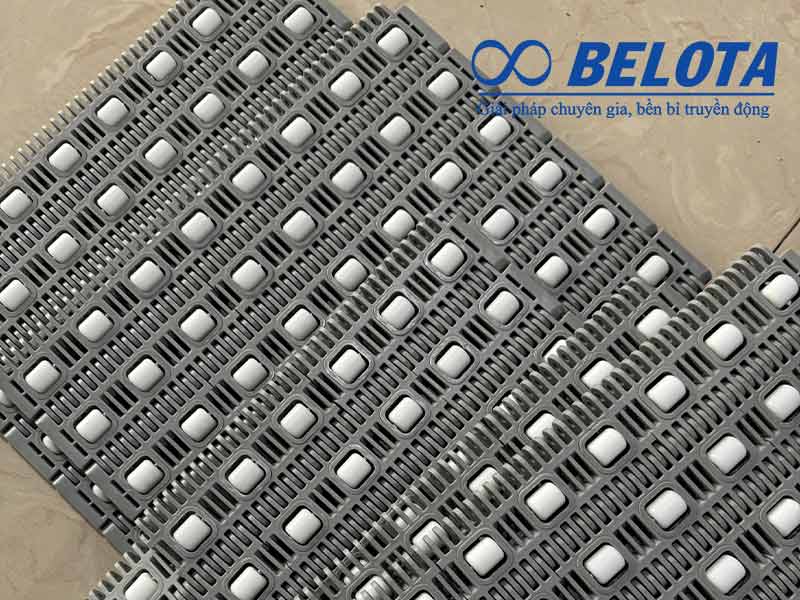
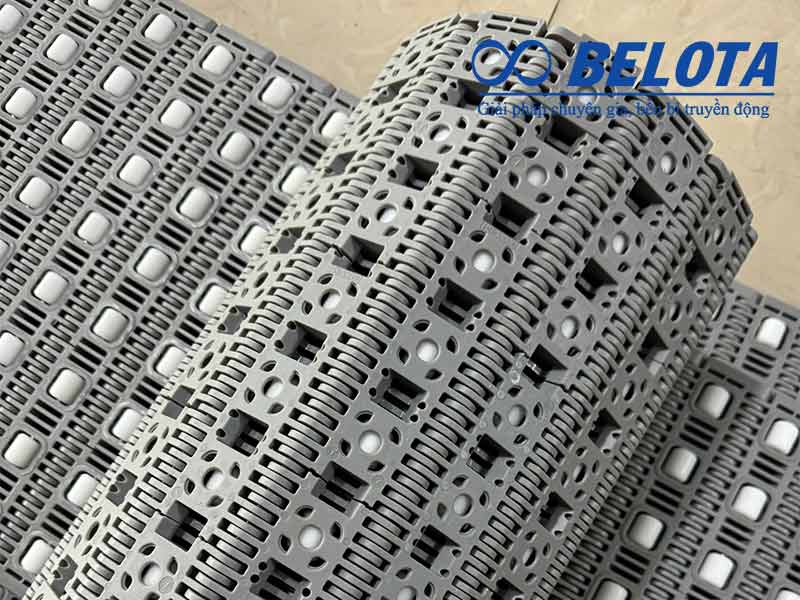
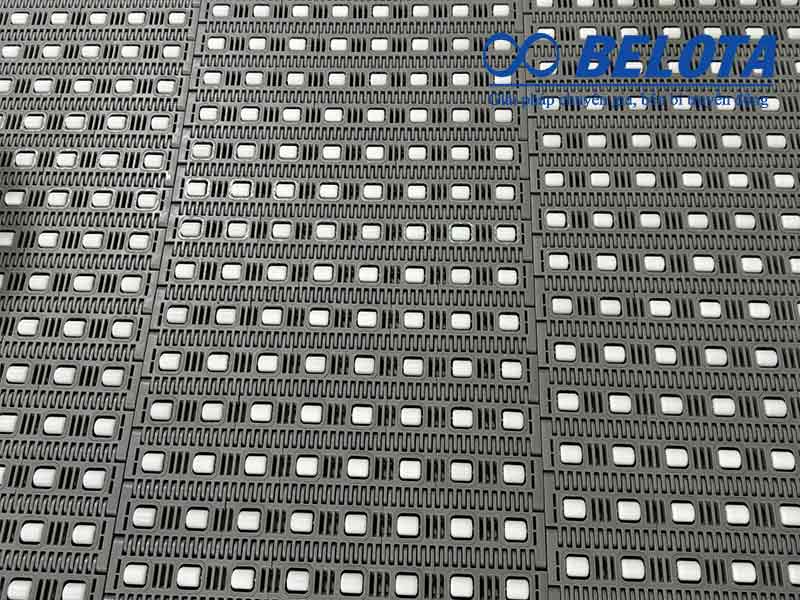
A plastic roller top conveyor belt is a modular plastic conveyor system featuring small free-spinning rollers integrated into the belt surface. Unlike standard flat-top modular belts, this design allows products to move or be diverted in multiple directions through the rotational movement of the rollers.
The system is specifically engineered for conveyor applications that require product redirection, sorting, merging, or lane changes while maintaining consistent throughput and operational reliability.
Construction of a Roller Top Modular Belt
The belt surface consists of two primary components:
Modular Plastic Links
Precision-molded plastic modules are interconnected to form a durable and flexible conveyor belt. The modular design allows individual sections to be replaced quickly, reducing maintenance time and minimizing downtime.
Integrated Rollers
Each module incorporates one or more rollers positioned at specific angles depending on the intended direction of product movement. These rollers rotate freely when products pass over them, enabling smooth directional changes directly on the belt surface.
How the Belt Works During Product Diversion
A roller top conveyor belt operates through the free rotation of its integrated rollers. As products reach a transfer or diversion point, they contact the rollers rather than sliding directly across a flat belt surface. When a lateral force is applied through guide rails, diverters, or conveyor geometry, the rollers rotate and help move products in the desired direction.
This rolling action significantly reduces friction between the product base and the conveyor surface by replacing sliding contact with rolling contact.
As a result, the system can:
- Smoothly redirect products around curves and transfer points
- Minimize jams and product misalignment
Enable side transfers, lane changes, product merging, and sorting operations
Compared with traditional flat-top belts, roller top belts offer better product control and lower resistance during directional changes, making them particularly valuable in high-throughput production environments.
Key Advantages in Real-World Applications
Reduced Friction
The roller-based design reduces surface friction by replacing sliding motion with rolling motion. This helps prevent product skewing and conveyor jams, especially in high-speed production lines where even minor disruptions can impact overall productivity.
Optimized Product Flow Around Curves
Integrated rollers allow products to change direction smoothly without requiring complex transfer mechanisms. Reduced resistance improves product tracking and minimizes rotation, accumulation, and collisions during conveying.
Unlike curved modular conveyor belts designed for continuous curved transport paths, roller top conveyor belts are primarily intended to optimize product transfers and directional changes at specific points within a conveyor system.
Improved Stability for Lightweight Products
Bottles, cans, pouches, and lightweight packaging benefit from improved movement control. The roller surface helps maintain product stability and reduces the risk of tipping during directional changes.
Lower Wear and Operating Costs
Rolling contact reduces wear on both the conveyor belt and product contact surfaces, extending service life and reducing maintenance requirements. This contributes to a lower total cost of ownership (TCO).
Increased Line Efficiency
By minimizing jams, reducing manual intervention, and improving product flow, roller top conveyor belts help increase conveyor uptime and overall production efficiency.
The roller structure enables smooth product movement through directional changes.
Common Applications
Plastic roller top conveyor belts are widely used in industries where reliable product diversion and transfer are essential.
- Food and Beverage Processing: Ideal for bottling, canning, and packaging lines. The roller surface helps maintain product stability while meeting hygiene and washdown requirements.
- Packaging and Carton Handling: Used for carton diversion, product routing, and case handling prior to downstream processing. Products can be redirected efficiently without manual handling.
- Logistics and Distribution Centers: Commonly integrated into sortation systems and fulfillment operations. Roller top belts help direct products quickly and accurately while reducing the risk of conveyor blockages.
Depending on the product characteristics and operational requirements, roller top conveyor belts can be customized to maximize system performance and product control.
Material Options and Performance Characteristics
The performance and lifespan of a roller top conveyor belt depend heavily on the materials used in the modules and rollers.
| Material | Key Characteristics | Operational Benefits |
|---|---|---|
| POM (Acetal) | High stiffness, excellent wear resistance, and a low coefficient of friction | Long service life, dimensional stability, and reliable performance under heavy loads |
| PP (Polypropylene) | Lightweight, excellent chemical resistance, and corrosion-resistant properties | Easy to clean, ideal for food processing and chemical environments, and cost-effective |
| PE (Polyethylene) | High toughness and excellent impact absorption | Gentle product handling and reduced risk of product damage during conveying |
Selecting the Right Roller Top Conveyor Belt
Based on Product Characteristics
Product size, shape, weight, and base configuration should be considered first. Small-base products often require a higher roller density to maintain stability during diversion.
Based on Diversion Requirements
The required diversion angle directly affects roller orientation. Minor directional changes may require simple configurations, while 90-degree transfers demand more precise roller positioning. For high-speed conveyor systems, durable materials with excellent dimensional stability are recommended.
Based on Environmental Conditions
Wet, washdown, or chemical environments typically require PP or PE materials due to their corrosion resistance and ease of cleaning. Dry operating environments may benefit from higher-stiffness materials such as POM for improved performance and longevity.
Best Practices for Efficient Operation
To maximize performance and service life:
Select the appropriate roller orientation for the intended product flow direction
- Avoid localized overloading beyond module load limits
- Ensure the product base size is compatible with the roller spacing
- Use suitable guide rails and transfer components for accurate product control
Frequently Asked Questions
What Is the Smallest Product Size Suitable for a Roller Top Conveyor Belt?
The minimum product size depends on roller density and module design. For stable conveying, the product base should contact at least three rollers simultaneously. Small bottles and containers typically require finer-pitch modules with higher roller density.
How Do I Clean Integrated Rollers?
Compressed air, low-pressure washdown systems, and compatible cleaning solutions can be used depending on the module material. Because the belt is modular, individual sections can be removed for deep cleaning or replacement if necessary.
Why Is My Product Not Diverting Properly?
Two common causes are:
- Roller orientation does not match the direction of the applied guide force.
- The product is too light to generate sufficient contact force for roller activation.
In these cases, conveyor speed, guide rail configuration, or roller orientation may need adjustment.
Conclusion
Plastic roller top conveyor belts provide an effective solution for reducing friction, improving product control, and enabling smooth directional changes within conveyor systems. By enhancing product stability and minimizing operational disruptions, these belts help improve overall line efficiency and productivity.
Belota supplies custom roller top conveyor belt solutions tailored to specific application requirements. Contact our team today for expert guidance on selecting the right conveyor system for your operation.