Mooncakes are among the most in-demand seasonal bakery products across many Asian markets, especially during the Mid-Autumn Festival. As demand surges within a short production window, manufacturers must maximize output while maintaining consistent product quality and food safety standards. To meet these challenges, modern bakeries increasingly integrate conveyor belts and automated equipment throughout the entire production line, from ingredient mixing and forming to baking, cooling, and final packaging. In this article, Belota explores the industrial mooncake manufacturing process and the conveyor solutions that help improve productivity, reduce labor costs, and ensure consistent product quality.
The Importance of Conveyor Systems in Mooncake Production Lines
In modern mooncake factories, conveyors do much more than simply transport products. They serve as the backbone that connects and synchronizes every stage of production.
From dough forming and pattern stamping to baking, cooling, and packaging, conveyor systems enable continuous product flow between workstations, reducing manual handling and improving operational efficiency.
By implementing the right conveyor solution, manufacturers can:
- Increase production throughput during peak Mid-Autumn Festival seasons.
- Improve food hygiene by minimizing direct product handling.
- Connect forming machines, stamping equipment, ovens, cooling lines, and packaging stations into a unified process.
- Reduce labor requirements and operational costs.
- Minimize product deformation and handling damage.
- Facilitate automation and smart production management.
- Maintain stable production speeds throughout the manufacturing process.
Key Criteria for Selecting Conveyors for Mooncake Production
To achieve high productivity while complying with food safety requirements, manufacturers should consider the following factors when selecting conveyors:
- Food-grade materials such as PVC conveyor belts, PVC conveyor belts, or stainless steel.
- Suitability for each production stage.
- Resistance to oil, sugar syrup, and moisture.
- Reliable operation during intensive seasonal production.
- Easy cleaning and maintenance.
- Compatibility with automated production and packaging equipment.
Industrial Mooncake Manufacturing Process
In large-scale bakeries and food processing facilities, mooncakes are typically produced through the following stages.
Ingredient Preparation and Dough & Filling Mixing
This initial stage lays the foundation for the quality of the final product. Ingredients such as flour, golden syrup, vegetable oil, lotus seed paste, mung bean paste, salted egg yolks, nuts, or mixed fillings are accurately weighed according to production formulas before processing.
For the dough, ingredients are blended using industrial dough mixers, ensuring uniform texture, elasticity, and consistency while significantly reducing preparation time compared to manual methods.
Meanwhile, mooncake fillings are processed using filling mixers or cooking kettles with continuous heating and mixing functions. These systems help achieve a smooth texture, stable consistency, and the distinctive flavor profile of each filling type.
Once prepared, both dough and filling are transferred to the forming area via food-grade white PVC conveyors or PU conveyor belts. Conveyor systems ensure continuous movement between processing stations while reducing manual contact and maintaining hygiene standards.
Before entering the forming process, fillings are portioned into uniform weights according to product specifications.
Mooncake Forming
At this stage, the dough and filling are combined to create the complete mooncake structure.
The process typically includes:
- Positioning the filling within the dough wrapper.
- Sealing and shaping the dough around the filling.
- Feeding the product into forming molds.
Large-scale manufacturers commonly utilize automatic mooncake forming machines integrated with conveyor systems to ensure uniform dimensions, accurate weight control, and consistent decorative patterns.
Food-grade PU conveyor belts, available in white or blue, are frequently used in this stage due to their clean surface, oil resistance, and non-stick properties.
After forming, products are automatically conveyed to the next production stage.
Pattern Stamping and Surface Finishing
Following forming, mooncakes move to the stamping section where decorative patterns or brand logos are applied. Food-grade PU conveyors maintain a steady conveying speed and minimize vibration, ensuring crisp and consistent surface patterns before baking.
Baking with Tunnel Oven Conveyor Systems
Baking is one of the most critical stages in mooncake production, directly affecting texture, flavor, color, and overall product quality.
Improper temperature control can lead to cracked surfaces, uneven baking, discoloration, or incomplete cooking.
Modern bakeries commonly use industrial tunnel ovens equipped with continuous conveyor systems. These systems move mooncakes through multiple temperature-controlled zones, ensuring uniform heat distribution and consistent product quality across production batches.
A typical baking process includes:
First Bake
- The initial baking stage sets the mooncake structure and partially cooks the crust.
- Typical temperature range: 180°C – 220°C
- Egg Wash Application
After partial cooling, a mixture of egg yolk, vegetable oil, or milk is applied to create the signature glossy golden finish.
Final Bake
The second baking cycle completes the cooking process and develops the desired golden-brown appearance.
Typical temperature range: 160°C – 200°C
For large-scale production lines, stainless steel mesh conveyor belts are widely used inside tunnel ovens. These conveyors provide excellent heat resistance, oxidation resistance, and dimensional stability when operating continuously at temperatures ranging from 200°C to over 300°C.
The open-mesh design allows hot air to circulate evenly above and below the products, improving heat transfer efficiency and ensuring more uniform baking compared to conventional tray-based methods.
This tunnel oven conveyor technology is also widely utilized in industrial sponge cake production lines, where precise temperature control is essential to achieve consistent volume, texture, and coloration.
Cooling and Quality Inspection
After baking, mooncakes are transferred to a cooling conveyor system to gradually reduce product temperature before packaging.
At this stage, operators inspect:
- Product shape and appearance.
- Surface color consistency.
- Internal baking quality.
Product defects and non-conforming items.
Cooling conveyors help prevent moisture condensation, maintain product integrity, and improve shelf-life stability.
Depending on production requirements, manufacturers may utilize either stainless steel mesh conveyors or food-grade PU conveyors.
Packaging and Sealing
Once fully cooled, mooncakes proceed to the packaging section.
Common equipment includes:
- Packaging conveyors.
- Automatic mooncake packaging machines.
- Heat-sealing machines.
- Date coding and printing systems.
These automated systems significantly improve packaging speed while ensuring hygiene and product presentation quality.
In heat-sealing operations, PTFE heat sealing belts are commonly used due to their excellent heat resistance, non-stick properties, and reliable performance under continuous operation.
Food-grade PU conveyors are also employed to transfer products into automatic packaging machines, ensuring smooth and uninterrupted workflow.
Belota – Conveyor Solutions for Mooncake Production Lines
For medium and large-scale mooncake manufacturers, selecting a reliable conveyor supplier is essential to maintaining stable production during peak seasonal demand.
Belota specializes in the design, fabrication, and supply of industrial conveyor systems for the food processing industry, including high-capacity mooncake production lines.
Our solutions include:
- Food-grade PVC conveyor systems.
- Food-grade PU conveyor belts.
- Heat-resistant stainless steel mesh conveyors.
- Cooling conveyors.
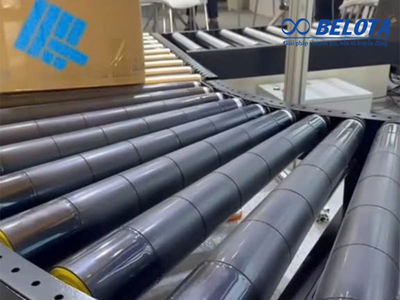
- Roller conveyors for packaging and finished goods handling.
Why Choose Belota?
- Custom-engineered solutions tailored to each production facility.
- Designed for high-volume, multi-shift operation during seasonal peaks.
- Food-grade materials that comply with hygiene requirements.
- Robust construction for long-term industrial use.
- Seamless integration with forming, baking, cooling, and packaging equipment.
- Professional consultation, site surveys, and production line optimization support.
Conclusion
Modern mooncake production combines traditional recipes with advanced automation technologies to improve efficiency, consistency, and product quality. From ingredient preparation and forming to baking, cooling, and packaging, conveyor systems play a vital role in creating a streamlined and reliable manufacturing process. Contact Belota today to explore industrial conveyor solutions designed to help your mooncake production line achieve higher productivity, improved food safety, and long-term operational reliability.


![Initial Belt Tension Adjustment Technique for Conveyor Belts [Detailed Guide]](https://belota.com.vn/image/initial-belt-tension-adjustment-technique-for-conveyor-belts-bg7bdsm.jpg?s=16)