Determining the correct V-belt length is an important factor in ensuring stable power transmission, reducing slippage, and extending equipment lifespan. However, not everyone knows how to calculate belt dimensions accurately or correctly read the specifications printed on the belt. In this article, Belota will guide you through practical methods for calculating and measuring V-belts, along with size charts and simple explanations for reading belt specifications in real-world applications.
What is V-Belt Size? Why Is It Important to Read Belt Dimensions Correctly?
V-belt size refers to the technical specifications that define the belt’s shape and dimensions, including length (inside length, outside length, or pitch length), width, thickness, and angle profile. These parameters directly affect installation compatibility and transmission efficiency.
Without knowing how to identify the correct belt size and code, users can easily encounter issues such as:
- Choosing the wrong belt length, causing loose or over-tight installation
- Selecting the wrong belt section (A, B, C, etc.), resulting in pulley mismatch
- Misreading the code printed on the belt and purchasing the wrong model
- Estimating dimensions visually instead of checking specifications
- Ignoring standards such as RMA or DIN, leading to incompatible replacement beltsThe Most Accurate Ways to Calculate V-Belt Size
How to Calculate Classical V-Belt Length
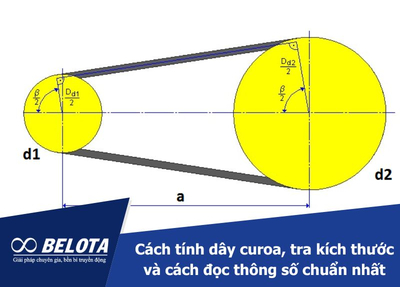
Method 1: Calculate Based on Pulley Diameter and Center Distance
Applicable for:
- Classical V-belts A, B, C, D, E
- SPZ, SPA, SPB, SPC profiles
- Two-pulley transmission systems
Formula: L=2C+[π(D+d)]/2+(D−d)2/4C
Where:
- L: Belt length (mm)
- C: Center distance between pulleys (mm)
- D: Large pulley diameter (mm)
- d: Small pulley diameter (mm)
- π ≈ 3.14
Example
- Large pulley diameter: D = 250 mm
- Small pulley diameter: d = 120 mm
- Center distance: C = 600 mm
Applying the formula: L ≈ 1476.24 mm
To convert from millimeters to inches: 1476.24 ÷ 25.4 ≈ 58.1 inches
Method 2: Measuring a V-Belt Using a Tape Measure
Preparation:
- Use a flexible, non-stretch measuring tape
- Identify the belt type or manufacturer standard (Li, Ld/Lw, La)
Steps:
- Mark a starting point on the belt.
- Measure and mark fixed intervals continuously.
- Rotate the belt until it completes one full loop.
- Add all measured sections together to determine the belt circumference.
Another practical method is cutting the old belt and laying it flat for direct measurement.
How to Calculate Timing Belt Length
Applicable for: XL, L, H, XH, HTD, AT series timing belts
Timing belts require higher precision, so the standard pulley-distance formula is usually not suitable.
Formula: L=Z×P
Where:
- L: Belt length
- Z: Number of teeth
- P: Tooth pitch
Example
For a T10 timing belt:
- Tooth pitch: 10 mm
- Number of teeth: 150
Result: L = 150 × 10 = 1500 mm
For timing belts, users should also identify:
- Tooth pitch
- Tooth profile
- Belt thickness
- Compatible pulley type
How to Calculate Flat Belt Length
Flat belts have a simpler structure and calculation formula.
Formula: L=2C+[π(D+d)]/2
Example
- Large pulley diameter: D = 300 mm
- Small pulley diameter: d = 150 mm
- Center distance: C = 700 mm
Result: L ≈ 2106.86 mm
Important Notes When Calculating Belt Length
- Identify the correct belt type (A, B, SPA, SPB, etc.)
- Distinguish between Li, Ld/Lw, and La standards
- Ensure accurate pulley and center distance measurements
- Use standard catalog sizes closest to the calculated value
- Consider 1–2% elongation when measuring used belts
- Avoid measuring systems with pulley misalignment
- For multi-groove pulley systems, replace all belts together instead of individually
Standard V-Belt Size Chart
Classical V-Belt Dimensions
| Belt Type | Width (mm) | Thickness (mm) | Angle |
|---|---|---|---|
| M/Z | 9.7 | 5.5 | 40° |
| A | 12.7 | 8.0 | 40° |
| B | 16.7 | 10.7 | 40° |
| C | 22.2 | 13.5 | 40° |
| D | 32.0 | 20.0 | 40° |
| E | 40.0 | 25.5 | 40° |
Timing Belt Specifications
| Belt Type | Pitch (mm) | Thickness (mm) |
|---|---|---|
| XL | 5.08 | 2.25 |
| L | 9.525 | 3.5 |
| H | 12.7 | 4.3 |
| XH | 22.225 | 11.3 |
| S3M | 3.0 | 2.10 |
| S5M | 5.0 | 3.61 |
Poly-V Belt Dimensions
| Belt Type | Pitch (mm) | Thickness (mm) |
|---|---|---|
| PH | 1.6 | 2.5 |
| PJ | 2.34 | 3.4 |
| PK | 3.56 | 4.3 |
How to Read V-Belt Specifications
Classical V-Belts (A, B, C, D, E)
Format: [Belt Section] + [Length]
Example: B60
→ Section B belt
→ Approximate length: 60 inches
Cogged V-Belts (RECMF)
Example: RECMF 8410
→ Section B belt
→ Length: 41 inches
Timing Belts
Format:
[Width] + [Belt Type] + [Length]
Example:
20-S3M-213
→ Width: 20 mm
→ Length: 213 mm
Wedge Belts (SPA, SPB, SPC)
Example: SPB 3450
→ SPB profile
→ Length: 3450 mm
Narrow V-Belts (3V, 5V, 8V)
Example: 3V500
→ Length: 50 inches
Variable Speed Belts
Example: 1422V240
Meaning:
- 14 = Approximate belt width
- 22V = Belt profile
- 240 = Belt length
Poly-V Belts
Example: 6PJ1000
→ 6 PJ ribs
→ Length: 1000 mm
Conclusion
Understanding how to calculate and identify the correct V-belt size is essential for maintaining stable transmission performance, minimizing downtime, and extending equipment lifespan. Whether using calculation formulas or direct measurement methods, the key is correctly identifying the belt type, length standard, and suitable catalog size.
Combining practical measurement, technical calculations, and size chart references allows users to select the correct belt more accurately, even when the original belt sample is unavailable. This also helps businesses reduce maintenance costs, prevent unexpected machine stoppages, and maintain long-term operational efficiency.