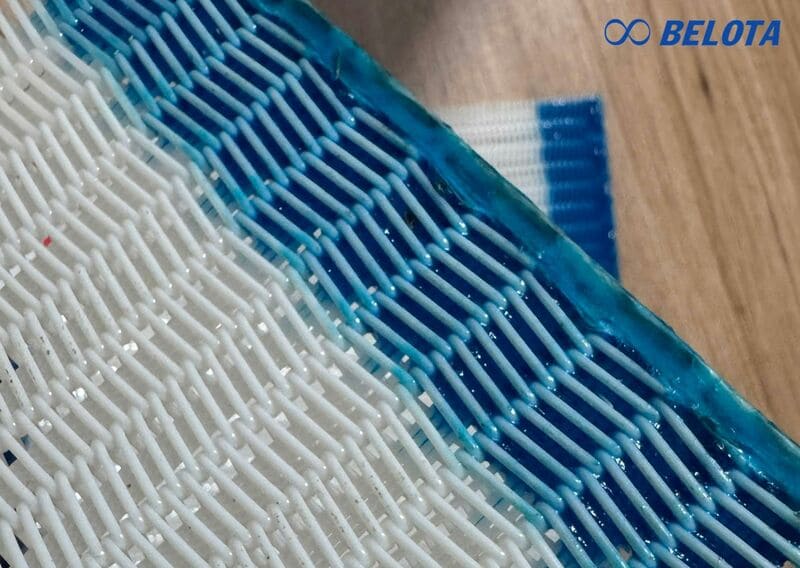
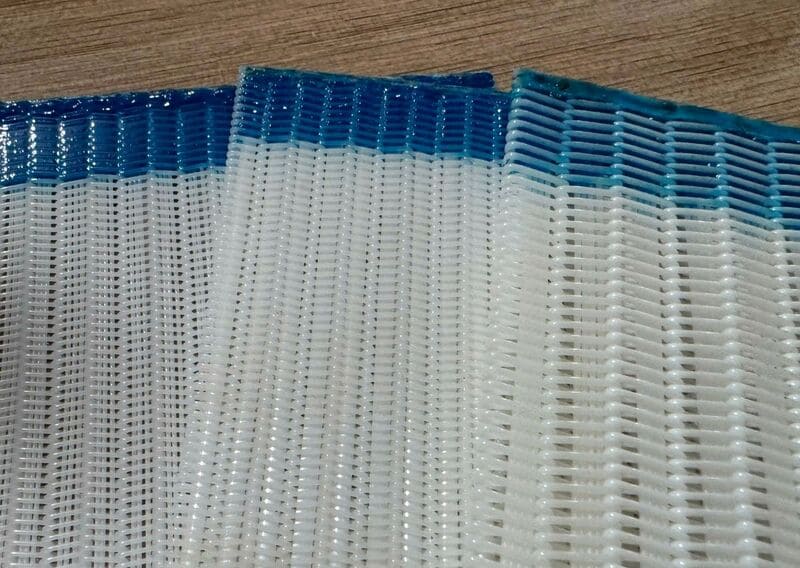
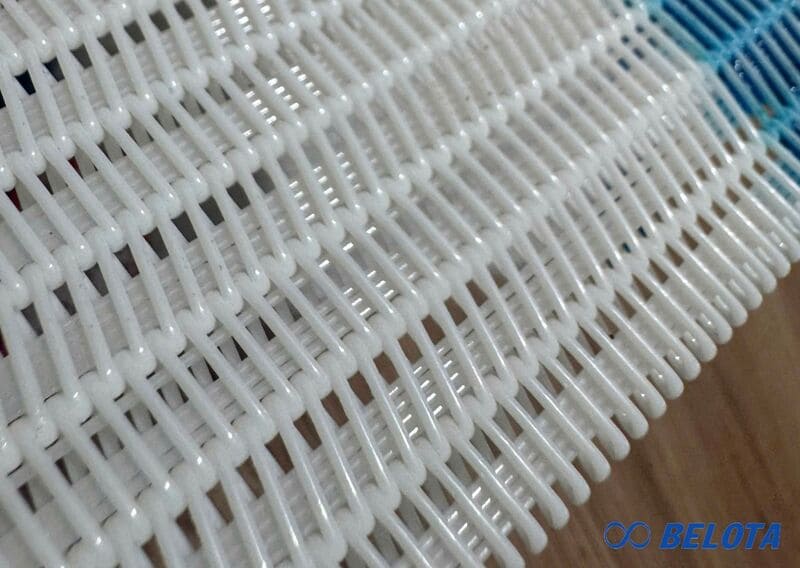
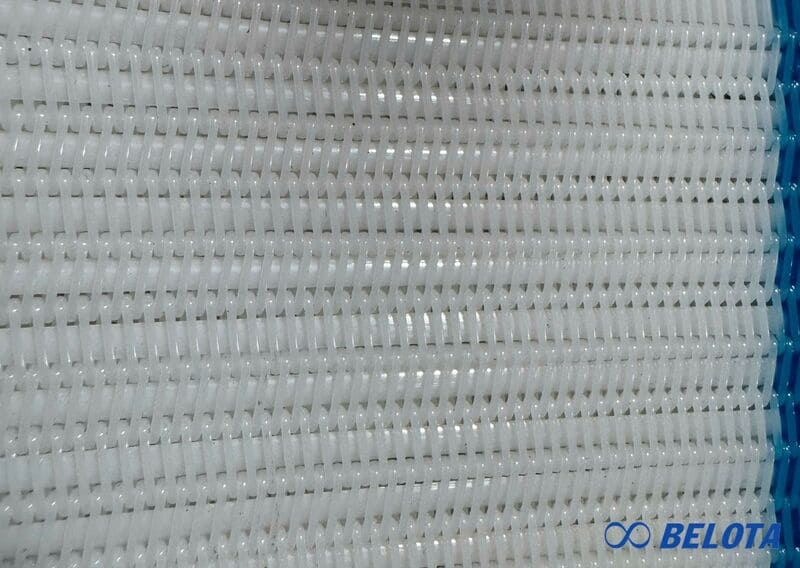
Reinforced Polyester Spiral Mesh Belt is a specialized mesh belt designed for belt filter presses, used to retain solids and support efficient dewatering. Its spiral structure combined with filler yarns helps control air permeability, improve belt stability, and adapt to different sludge treatment conditions. Depending on the sludge characteristics, drainage requirements, and machine configuration, users can select the appropriate spiral size, yarn material, and belt model. In this article, let’s explore the key features, applications, and how to choose the right size with Belota.
What Is a Reinforced Polyester Spiral Mesh Belt?
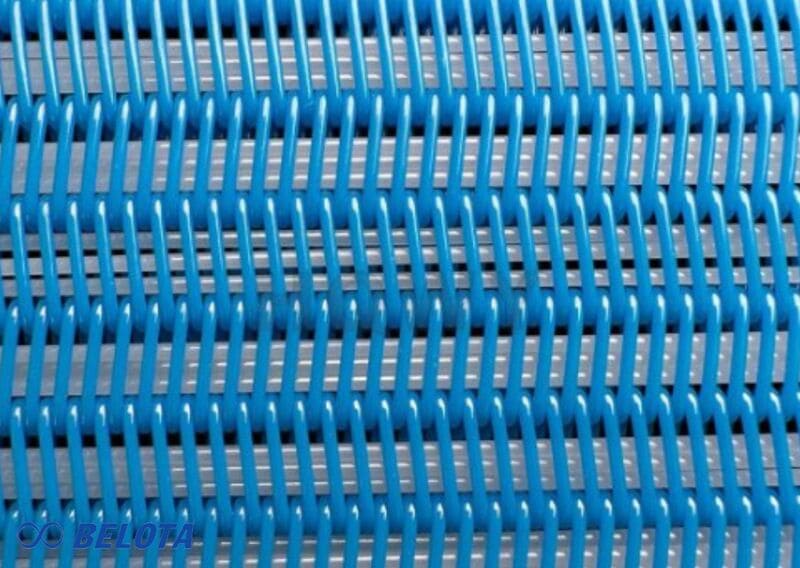
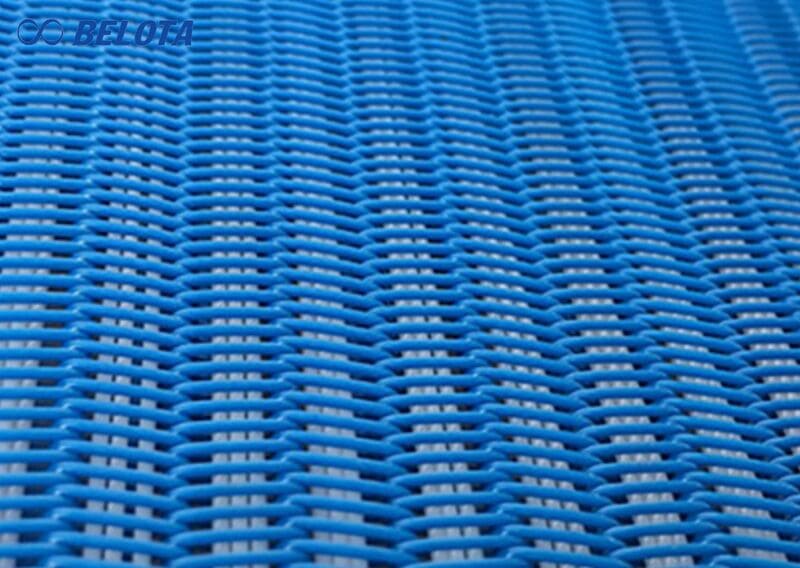
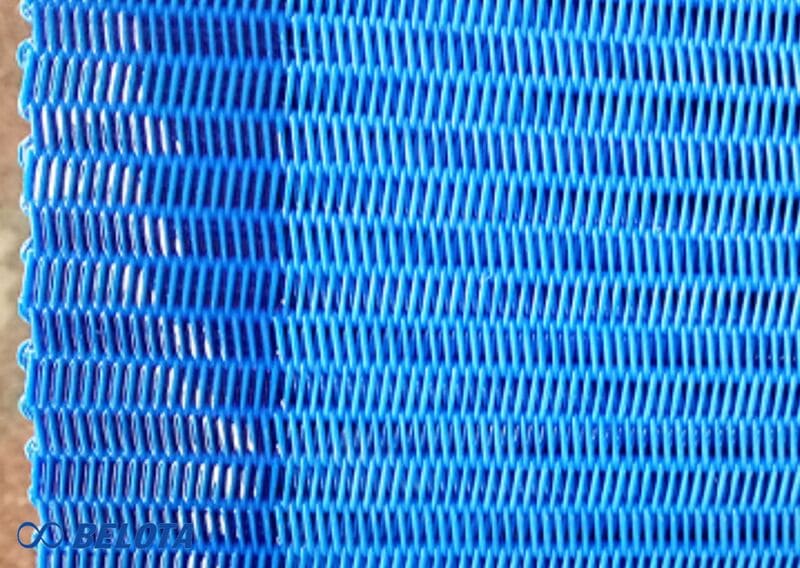
Reinforced Polyester Spiral Mesh Belt is a specialized Polyester mesh belt for industrial filtration and sludge dewatering. It is made from wear-resistant polyester monofilament spirals. The spirals are interconnected by connecting pins and reinforced with filler yarns to adjust air permeability, improve solids retention, and stabilize the belt structure during the dewatering process.
Thanks to its spiral structure, the belt provides suitable permeability, good drainage performance, and stable operation under continuous working conditions. Spiral Press Filter Belts are widely used in municipal and industrial wastewater treatment systems, as well as in industries such as mining, chemical processing, food processing, and paper manufacturing.
Construction of Reinforced Polyester Spiral Mesh Belt
- Spiral loops: The main structural component of the belt, available in three sizes: small (5.2 mm pitch, 0.5 mm spiral diameter), medium (7.15–8 mm pitch, 0.68 mm spiral diameter), and large (8 - 12 mm pitch, 0.9 - 1.2 mm spiral diameter). The spiral size is selected according to drainage requirements and solids retention.
- Reinforcement filler yarns: The spaces between the spiral loops are filled with round yarns, flat wires, or conductive carbon yarns. These fillers help control permeability, improve solids retention, and provide better control of the dewatering process compared with a standard Polyester spiral mesh belt.
- Spiral joint: The two belt ends are connected by a connecting pin inserted through the interlocking spiral loops, creating a joint integrated with the belt body without the need for metal clips. The connecting pin can be round or flat depending on the machine configuration.
- Edge reinforcement: The belt edges are treated with high-strength adhesive to reduce yarn fraying and improve stability when running over rollers. Fold-Back Yarns Glued Edge or Cut Glued Edge can be used.
Technical Specifications of Spiral Press Filter Belt
- Belt width: 200 - 5,000 mm, customizable according to equipment requirements.
- Belt length: Custom manufactured according to the actual dimensions and circumference of the belt filter press.
- Material: Wear-resistant polyester monofilament or alkali-resistant polyamide (PA/Nylon).
- Reinforcement filler yarns:
- Round yarn: Diameter 0.60 - 1.2 mm, 3 or 4 yarns per loop.
- Flat yarn: 2.1 × 0.80 mm or 2.1 × 0.88 mm.
- Conductive carbon filler yarn: Model 6890B5, providing antistatic performance for specialized applications.
- Food safety standards: FDA 21 CFR and EU EC 1935/2004 for selected models used in food and pharmaceutical applications.
- Edge reinforcement: Fold-Back Yarns Glued Edge and Cut Glued Edge.
- Belt connecting pin: Available in standard Round or thin Flat types for different press gap configurations.
- Joint type: The connecting pin is inserted through the interlocking spiral loops to create a joint integrated with the belt body.
Detailed Technical Specifications of 12 Standard Models
| Loop Group | Model | Spiral Pitch (mm) | Spiral Diameter (mm) | Pin Diameter (mm) | Filler Yarn | Tensile Strength (N/cm) | Weight (kg/m²) | Thickness (mm) | Air Permeability (m³/m²h) | CFM (127 Pa) |
|---|---|---|---|---|---|---|---|---|---|---|
| Small Loop | 5080A1 | 5.2 | 0.5 | 0.8 | Round 0.60 × 3 yarns | 1,800 | 1.5 | 2.1 | 4,480 | 280 |
| Medium Loop | 6890A1 | 8.0 | 0.68 | 0.9 | Round 0.80 × 4 yarns | 2,000 | 2.0 | 2.45 | 6,080 | 380 |
| 6890B1 | 7.15 | 0.68 | 0.9 | Round 0.90 × 3 yarns | 2,000 | 1.9 | 2.45 | 5,760 | 360 | |
| 6890B2 | 7.15 | 0.68 | 0.9 | Round 0.80 × 3 yarns | 2,000 | 1.85 | 2.45 | 7,750 | 484 | |
| 6890B3 | 7.15 | 0.68 | 0.9 | Flat wire 2.1 × 0.80 | 2,000 | 1.8 | 2.45 | 9,000 | 563 | |
| 6890B4 | 7.15 | 0.68 | 0.9 | Flat wire 2.1 × 0.88 | 2,000 | 1.85 | 2.45 | 8,000 | 500 | |
| 6890B5 | 7.15 | 0.68 | 0.9 | Conductive carbon yarn | 2,000 | 1.6 | 2.45 | 10,000 | 625 | |
| Large Loop | 9090A1 | 8.0 | 0.9 | 0.9 | Round 0.90 × 3 yarns | 2,300 | 2.3 | 3.03 | 7,500 | 468 |
| 90110A1 | 10.0 | 0.9 | 1.1 | Round 1.0 × 4 yarns | 2,000 | 2.4 | 3.15 | 6,240 | 390 | |
| 10090A1 | 8.0 | 1.0 | 0.9 | Round 1.0 × 3 yarns | 2,000 | 2.5 | 3.6 | 5,000 | 315 | |
| 120130A1 | 12.0 | 1.2 | 1.3 | Round 1.2 × 3 yarns | 2,600 | 2.85 | 4.3 | 7,500 | 468 | |
| Alkali Resistant (PA) | PA90110A2 | 10.0 | 0.9 | 1.1 | Round 1.2 × 3 yarns | 2,000 | 2.25 | 3.15 | 6,240 | 390 |
Air permeability is measured at a differential pressure of 127 Pa.
Advantages of Reinforced Spiral Mesh Belt
- Higher strength and load resistance: Filler yarns help stabilize the belt structure and withstand tension and pressure during continuous operation through press rollers.
- Reduced risk of joint failure: The connecting pin passes through the interlocking spiral loops, creating a joint integrated with the belt body and reducing the risk of separation, breakage, or tearing found in some mechanically clipped woven belts.
- Controlled permeability and improved solids retention: Filler yarns adjust the openings between the spiral loops, helping reduce the loss of fine sludge while maintaining good drainage.
- Good abrasion resistance: Polyester or polyamide monofilaments provide good resistance to friction from rollers, scrapers, and sludge cakes during continuous dewatering.
- Stable operation: Adhesive-reinforced edges help reduce yarn fraying, deformation, and belt width instability during operation.
- Suitable for different working environments: Polyester, alkali-resistant polyamide, or conductive carbon yarns can be selected depending on sludge and chemical conditions.
- Food-grade options: Selected materials can comply with FDA 21 CFR and EU EC 1935/2004 for filtration applications in food, beverage, and pharmaceutical processing.
Applications of Reinforced Polyester Spiral Mesh Belt
- Wastewater treatment: Dewatering and separation of biological sludge, primary sludge, and secondary sludge in municipal and industrial wastewater treatment plants.
- Mining and mineral processing: Dewatering ore sludge and tailings, sand washing, and processing minerals such as phosphate, kaolin, and silica.
- Chemical and pharmaceutical industries: Filtration of chemical sludge, solids recovery, and pharmaceutical raw material processing. PA/Nylon models can be selected for highly alkaline environments.
- Food and beverage processing: Filtration of fruit and vegetable juices, starch, sugar, and other materials requiring controlled permeability.
- Pulp and paper: Dewatering paper mill sludge, fiber recovery, and treatment of pigment or coating sludge.
- Textile and light industries: Treatment of sludge from textile dyeing, leather processing, printing, and selected food processing operations.
Edge Gluing Options for Spiral Press Filter Belt
Two common edge reinforcement options are available:
Fold-Back Yarns Glued Edge
The yarn ends along the belt edge are folded back and secured with a flexible, high-strength adhesive, creating a thicker and stronger edge. This design improves edge abrasion resistance, reduces yarn displacement, and helps maintain stable belt tracking on flat roller systems. It is suitable for belt filter presses using standard edge guide channels.
Cut Glued Edge
The belt is precisely cut to the required width, and the cut edge is sealed with a flexible adhesive. This creates a thin, clean edge suitable for machines with narrow guide channels or tight clearance requirements. It is a common option for many standard belt filter press configurations.
Common adhesive properties: Both reinforcement methods use adhesives with good lateral strength and delamination resistance to stabilize the filler yarns during pressing. Depending on the operating environment, edge adhesive materials can be selected for resistance to acidic or alkaline conditions and high-pressure belt cleaning.
Comparison of Round vs. Flat Reinforcement Pins and Yarns
Spiral press filter belts can use round or flat connecting pins and filler yarns, depending on the requirements for joint thickness, permeability, and drainage performance.
Round Reinforcement Pins and Yarns
- Connecting pin: Round cross-section, providing relatively even tensile load distribution through the spiral loops.
- Filler yarn: Round monofilament with a diameter of 0.60–1.2 mm, typically 3–4 yarns per spiral loop.
- Air permeability: Approximately 4,480–7,750 m³/m²h, depending on yarn diameter and quantity.
- Applications: Suitable for standard belt filter presses in wastewater treatment, mining, and food processing.
- Advantages: Common configuration, easy to select, and allows permeability to be adjusted according to requirements.
Flat Reinforcement Pins and Yarns
- Connecting pin: Flat cross-section, creating a low-profile joint and a more even belt surface.
- Filler yarn: Flat wire measuring 2.1 × 0.80 mm or 2.1 × 0.88 mm.
- Air permeability: Approximately 8,000–9,000 m³/m²h, providing higher drainage capacity.
- Applications: Suitable for machines with narrow press roller gaps or high drainage flow requirements.
- Advantages: Compact joint, low surface protrusion, and improved drainage without significantly increasing belt thickness.
Guide to Selecting the Appropriate Loop Size and Configuration
| Loop Type | Typical Applications | Recommended Models | Air Permeability |
|---|---|---|---|
| Small loop (5.2 mm pitch) | Fine solids retention, pharmaceutical filtration, and sludge dewatering requiring low permeability | 5080A1 | 4,480 m³/m²h |
| Medium loop (7.15–8 mm pitch) | Sludge dewatering, wastewater treatment, chemical and food filtration | 6890A1, 6890B1, 6890B2, 6890B3, 6890B4, 6890B5 | 5,760–10,000 m³/m²h |
| Large loop (8–12 mm pitch) | Mining, mineral dewatering, sand washing, pulp and paper; suitable for coarse solid-liquid separation | 9090A1, 90110A1, 10090A1, 120130A1 | 5,000–7,500 m³/m²h |
| Alkali-resistant (PA/Nylon) | Alkaline solution washing, high-pH industrial sludge, and alkaline chemical filtration | PA90110A2 | 6,240 m³/m²h |
Frequently Asked Questions About Reinforced Polyester Spiral Mesh Belts
What Are Filler Yarns and Why Are They Important for Filtration Performance?
Filler yarns are inserted between the spiral loops to reduce the openings and adjust the belt's permeability.
- Better sludge retention: Helps reduce the loss of fine solids through the belt.
- Controlled permeability: Regulates the flow of water and air through the belt, supporting filter cake formation.
- Stable performance: Helps maintain a relatively consistent structure and opening during operation.
Filler yarns can be round yarns, flat wires, or conductive carbon yarns, depending on the filtration requirements.
What Is a Spiral Filter Belt and How Does It Differ From a Woven Belt?
A spiral filter belt is made from polyester monofilaments interconnected into spiral loops and joined with a connecting pin rather than being woven on a textile frame.
Key differences include:
- Joint: Spiral belts are joined by inserting a connecting pin through the spiral loops, creating an integrated joint.
- Woven belt: The two ends are commonly joined using mechanical clips, creating a separate joint section.
- Permeability: Spiral belts can incorporate filler yarns to adjust permeability according to filtration requirements.
- Structure: The spiral construction helps maintain consistent openings and drainage performance during operation.
Why Can Mechanical Seams Fail and How Does the Spiral Structure Help?
In a belt filter press, mechanical seams are continuously exposed to tension, bending, and high pressure as the belt passes through the rollers. This makes the joint an area where stress can concentrate, potentially causing mechanical clips or connecting components to fatigue and fail before the main belt body.
With a spiral filter belt, the two belt ends are connected by interlocking the spiral loops and inserting a connecting pin. Because the joint follows a structure similar to the belt body, the load can be distributed more evenly during bending and pressing, helping reduce stress concentration and the risk of joint failure.
Conclusion
Reinforced Polyester Spiral Mesh Belt provides flexibility in controlling permeability, solids retention, and belt strength during continuous operation. Selecting the appropriate spiral size, filler yarn type, edge reinforcement, and belt model should be based on the sludge characteristics, dewatering requirements, and actual specifications of the belt filter press to ensure stable filtration performance and service life.