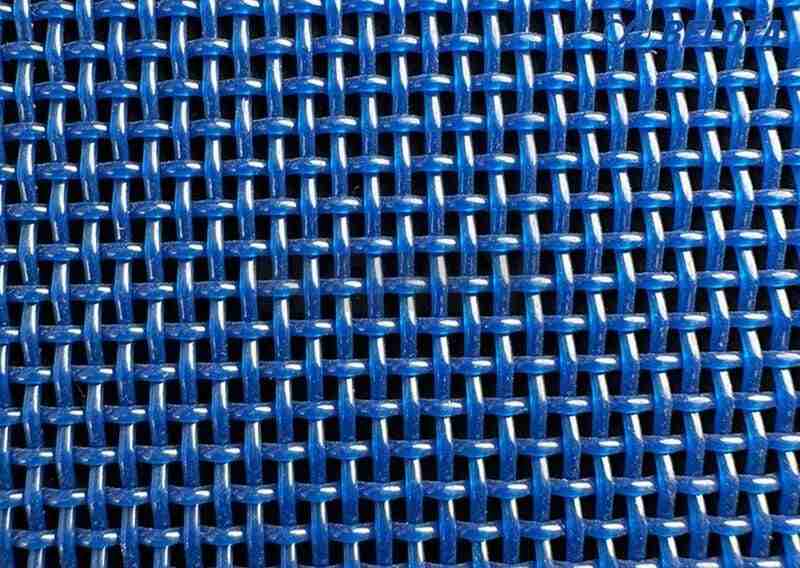
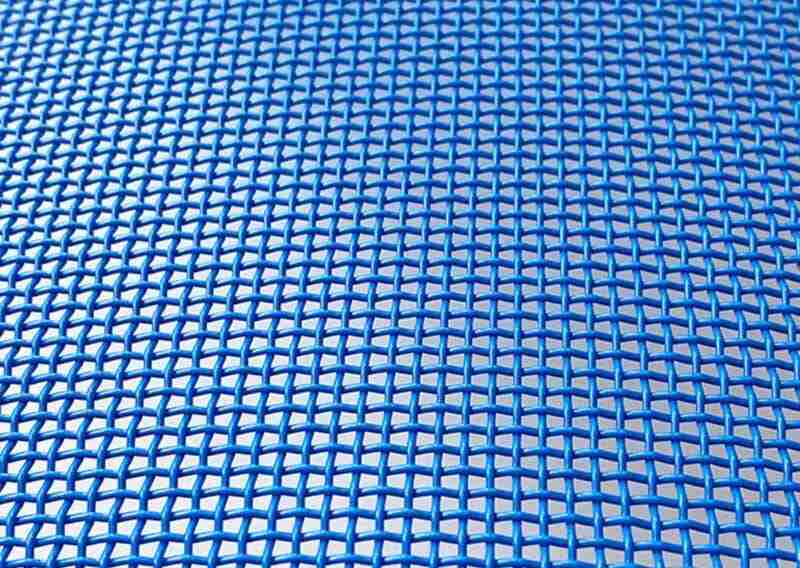
The Polyester Linear Screen Mesh Conveyor Belt is available in two main weaving structures, 2-shaft and 3-shaft, designed to meet different requirements for conveying, drainage, filtration, and material handling. Understanding the characteristics of each type helps businesses determine the right specifications before selecting and installing the belt. This guide covers the belt's construction, weave types, mesh openings, technical specifications, joining methods, edge options, and applications, providing a practical reference for selecting the right belt for different production lines.
What Is a Polyester Linear Screen Mesh Conveyor Belt?
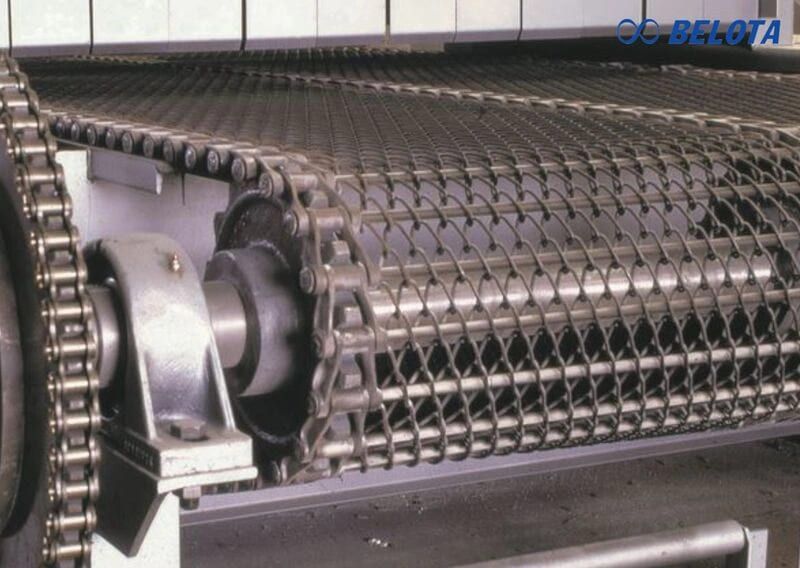
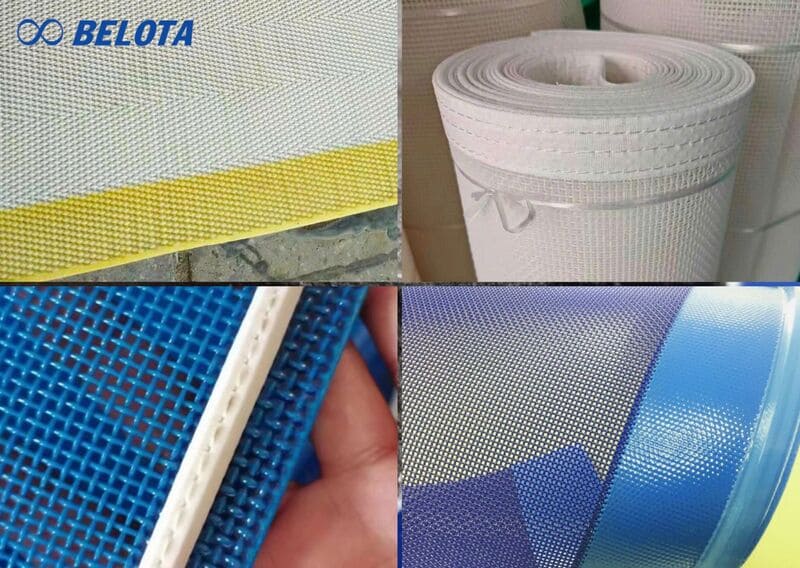
The Polyester Linear Screen Mesh Conveyor Belt is woven from polyester monofilament yarns to create a relatively flat surface with evenly distributed mesh openings. This structure allows the belt to support and convey materials while allowing water, liquids, or air to pass through the open mesh.
The belt is commonly used for filtration, dewatering, sludge pressing, washing, drying, and wet material handling. Depending on the application, mesh opening, permeability, thickness, and tensile strength can be customized to suit different machines and operating conditions.
Technical Specifications
- Product name: Polyester Linear Screen Mesh Conveyor Belt
- Also known as: Polyester filter belt, polyester screening mesh
- Material: 100% polyester (PET) monofilament
- Weave: 2-shaft plain weave or 3-shaft weave
- Mesh opening: Approximately 0.4–5.0 mm
- Width: Up to approximately 5.6 m or customized
- Length: Customized according to requirements
- Operating temperature: Approximately -75°C to +150°C
- Edge and joining options: Various edge treatments and joining methods available
- Standards: Depending on the configuration, belts can meet US FDA and EU food-contact requirements, including EU 10/2011
Advantages and Features of Polyester Linear Screen Mesh Conveyor Belt
The Polyester Linear Screen Mesh Conveyor Belt offers stable construction, excellent drainage, and flexible options for yarn materials, joints, and edge treatments.
Uniform Mesh Openings
The precise weaving structure helps maintain consistent mesh size and shape across the belt width, supporting accurate filtration, screening, classification, and dewatering.
High Dimensional Stability
Controlled heat treatment reduces internal stress in the yarns, helping minimize stretching and deformation during continuous operation.
Suitable for Food Processing
High-quality PET monofilament can meet FDA and EU food-contact requirements. The smooth woven surface is also easy to clean and helps minimize product buildup.
Good Durability and Abrasion Resistance
Polyester yarn provides good mechanical strength and abrasion resistance for continuous operation. The 3-shaft weave can be selected when higher load capacity and wear resistance are required.
Flexible Joining and Edge Options
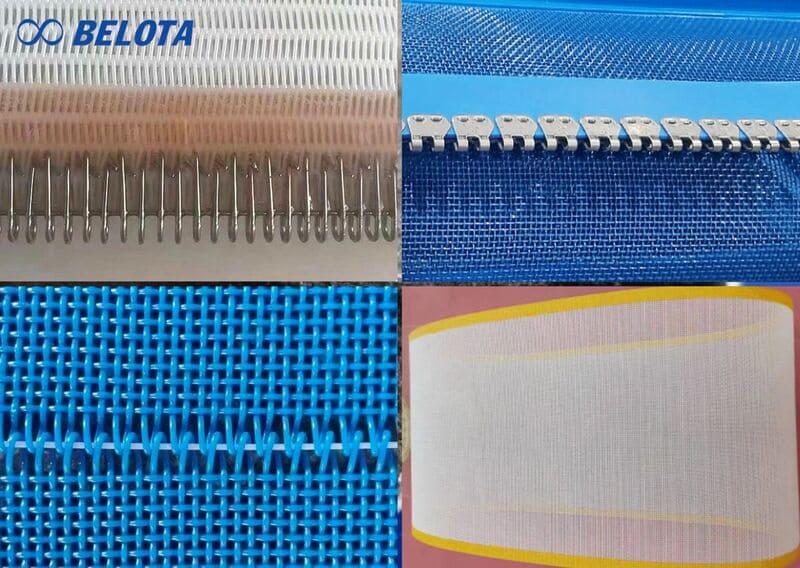
The belt can be supplied with various joining methods, including metal clipper fasteners, pin joints, integrated spiral joints, and seamless joints. Edges can also be sealed, sewn, fitted with tracking guides, or reinforced with PVC/TPU, including configurations such as sealed-edge polyester mesh conveyor belts.
Wide Temperature and Chemical Resistance
Different yarn materials can be selected according to operating conditions. PET is suitable for standard applications, while hydrolysis-resistant PET is designed for environments combining high temperature and high humidity.
Weave Structures of Polyester Linear Screen Mesh Conveyor Belt
2-Shaft Plain Weave Standard
The 2-shaft plain weave is suitable for food drying, fruit and vegetable washing, mineral screening, and dewatering processes where accurate and consistent mesh openings are important.
- Uniform mesh openings: Support effective particle separation and classification.
- High weaving stability: Maintains relatively consistent mesh dimensions across the belt width.
- Smooth surface: Reduces product buildup and facilitates cleaning.
- Mesh opening: Approximately 400 - 5,000 µm, available in square or rectangular configurations.
3-Shaft Weave Heavy Duty
The 3-shaft weave is designed for wood chip drying, mineral processing, abrasive materials, and continuous heavy-duty operation.
- Fast drainage: The weave structure provides high permeability and efficient drainage.
- Higher load and abrasion resistance: More robust construction than the 2-shaft weave for heavy or abrasive materials.
- Long service life: Maintains performance under high loads and continuous high-speed operation.
- Anti-static option: Special anti-static yarns are available for processes requiring static control.
Joining Methods for Polyester Linear Screen Mesh Conveyor Belt
Four common joining methods are available for both 2-shaft and 3-shaft belts. The appropriate option depends on belt tension, equipment design, material characteristics, and hygiene requirements.
- Clipper metal fastener: Quick to install and replace; suitable for belt presses and linear screening equipment.
- Pin joint: Thin and compact design with good gripping performance; suitable for small or sensitive materials.
- Integrated spiral joint: Strong, open, and easy to clean; suitable for food processing and high-tension applications.
- Seamless joint: Creates a continuous belt surface without a raised joining element; suitable for applications requiring a uniform surface and precise filtration.
Edge Treatment Options for Polyester Linear Screen Mesh Conveyor Belt
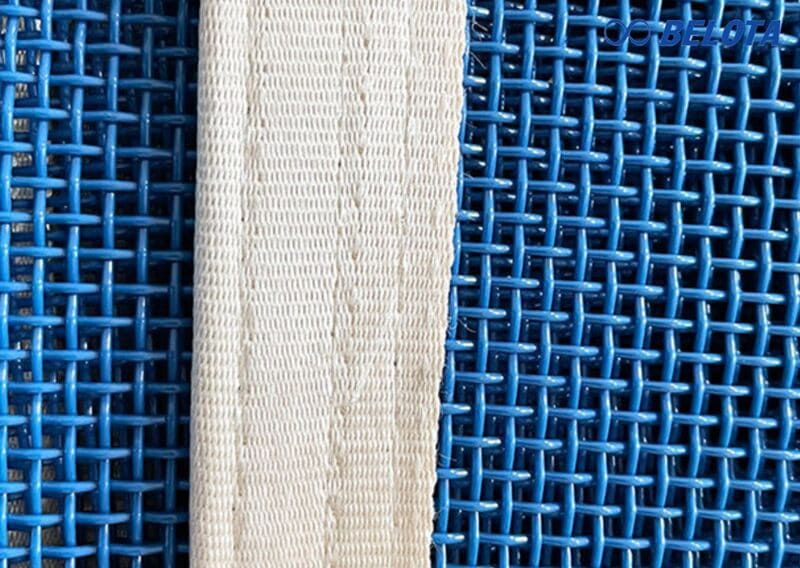
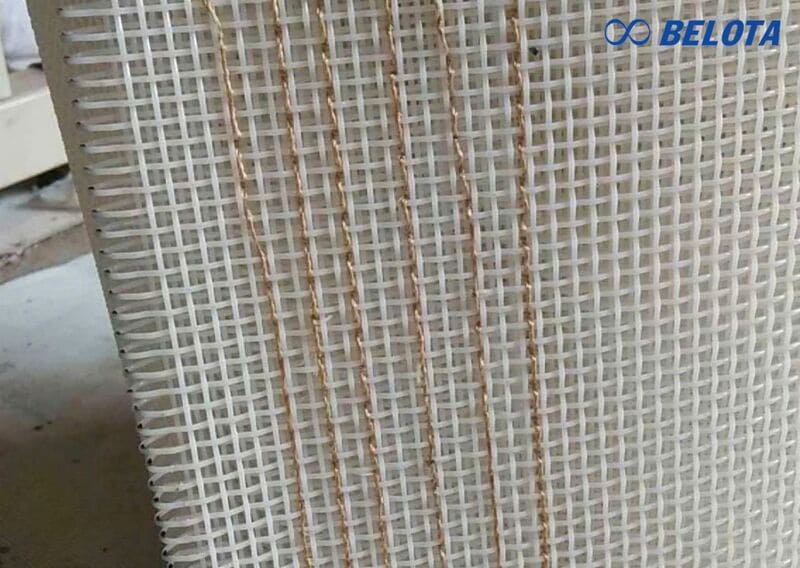
Polyester mesh belts can be reinforced and finished in different ways to reduce fraying, improve edge strength, and maintain belt tracking stability.
- Adhesive-sealed edge: The mesh edges are coated with adhesive or resin to secure the yarns and reduce fraying; suitable for standard applications.
- Sewn edge: Reinforced stitching improves mechanical strength and load resistance, making it suitable for heavy-duty industrial systems.
- Edge tracking guide: A V-shaped guide or positioning cord helps keep the belt centered and reduces lateral movement during operation.
- PVC/TPU coating + V-guide: Provides enhanced edge protection while supporting belt tracking; suitable for wide belts and high-speed systems.
Applications of Polyester Linear Screen Mesh Conveyor Belt
Food Processing, Drying and Washing
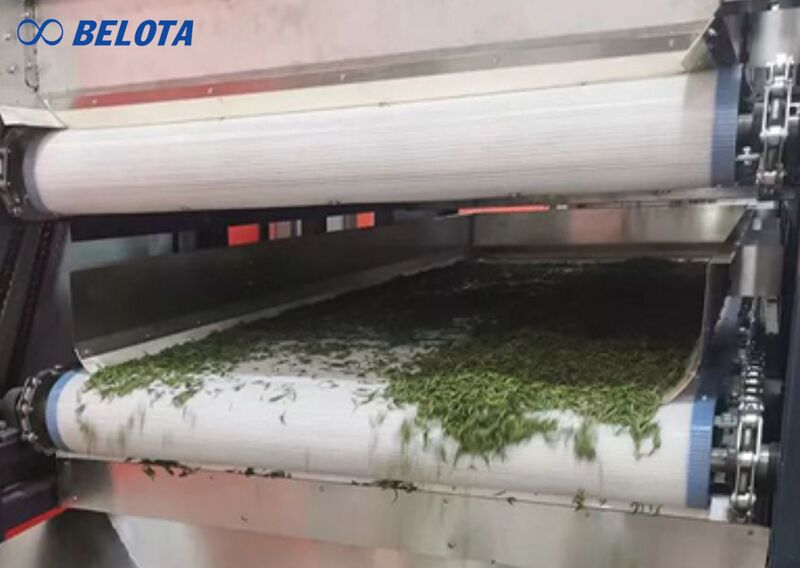
The belt is suitable for washing and conveying fruits and vegetables, drying noodles, snacks, seafood, tea, coffee, herbs, and seasonings. It is also used for poultry processing, frozen food, sugar, and salt handling. The smooth mesh surface facilitates cleaning while providing efficient drainage and airflow.
Recommended mesh opening: 500–3,000 µm.
Mining and Mineral Screening
Used for coal washing, gravel washing, mineral screening, salt dewatering, and mineral sludge processing. The 3-shaft weave provides good abrasion resistance, while PET or PP yarns can be selected for acidic, alkaline, or chemical environments.
Recommended mesh opening: 400–2,000 µm.
Sludge Dewatering and Wastewater Treatment
Used in belt filter presses for dewatering municipal sludge, industrial sludge, paper mill sludge, chemical sludge, and sludge from flue gas treatment processes. The open mesh provides efficient drainage and easy cleaning, while different yarn materials can be selected according to chemical conditions.
Recommended mesh opening: 400–1,600 µm.
Nonwoven Production
The belt is used for forming, drying, and processing spunbond, meltblown, airlaid, spunlace, and wet-laid nonwoven materials. Its dimensional stability and uniform air permeability help maintain consistent airflow during production.
Recommended mesh opening: 1,000–3,000 µm.
Wood Processing and Engineered Wood Panels
Suitable for wood chip drying, MDF/HDF and OSB forming and drying, as well as ventilation and resin distribution processes. The 3-shaft weave provides high strength for heavy loads and elevated-temperature operating conditions.
Recommended mesh opening: 2,000–5,000 µm.
Paper and Pulp Production
Used for pulp forming, pulp dewatering, sludge processing, and pulp washing. The precise mesh structure helps control drainage and maintain stable material forming performance.
Recommended mesh opening: 400–2,000 µm.
Other Applications
The Polyester Linear Screen Mesh Conveyor Belt is also used in:
- Chemical processing: Filtration, separation, and material conveying in chemical environments.
- Pharmaceutical processing: Drying and handling of raw materials.
- Aquaculture: Washing, conveying, and dewatering aquatic products.
- Fiberglass mat production: Material forming and processing.
- Fruit and vegetable processing: Washing, cleaning, and dewatering.
- Screening and classification: Separating materials according to particle size.
Conclusion
Selecting the right weave structure, mesh opening, yarn material, joining method, and edge treatment helps ensure stable belt performance under specific production conditions. Before ordering, businesses should compare the belt specifications with the conveyor design, material characteristics, operating temperature, belt tension, and required filtration or drainage performance.
Belota supplies the Polyester Linear Screen Mesh Conveyor Belt in various specifications and configurations, with technical support to help customers select the appropriate belt for their specific production line.