In seafood processing plants, conveyor belts play an essential role in moving raw materials and finished products through various stages, including receiving, washing, preparation, sorting, freezing, and packaging. Each stage has its own requirements for hygiene, drainage, and operating conditions. Choosing the right conveyor belt helps minimize product damage, reduce cleaning time, and keep production running smoothly. This article explores the most commonly used conveyor belt types in seafood processing, their key features, and how to select the right belt for each stage of production.
Operating Conditions of Conveyor Belts in Seafood Processing
Unlike many dry manufacturing environments, seafood processing lines are constantly exposed to water, salt, grease, raw material residues, and cleaning chemicals. These conditions directly affect conveyor belt service life and hygiene performance. The main operating challenges include:
- Wet and saltwater environments: Conveyor frames, joints, bearings, and metal components may corrode if unsuitable materials are used.
- Strict hygiene requirements: Food-contact surfaces must be easy to clean, with minimal gaps where residue and contaminants can accumulate.
- Temperature fluctuations: Products may move from ambient-temperature preparation areas to chilled rooms or blast-freezing tunnels.
- Delicate products: Shrimp, fish fillets, and squid can bruise, tear, or shift if the belt surface and transfer points are not properly designed.
- Continuous operation: Conveyor belts must handle the required production capacity while allowing convenient maintenance and replacement when needed.
Requirements for Conveyor Belts Used in Seafood Processing
To perform reliably in wet processing environments and maintain food hygiene, conveyor belts used in the seafood industry should meet the following requirements:
- Food safety certification: Belts that come into direct contact with shrimp, fish, and squid should have certifications or compliance documentation for food contact, such as FDA or EU 1935/2004, depending on the target market and plant requirements.
- Moisture and corrosion resistance: Belts must withstand exposure to water, salt, and cleaning chemicals. Stainless steel components should be made from Grade 304 or 316, depending on the operating environment.
- Easy cleaning: Belt surfaces should resist product buildup, minimize dirt-trapping gaps, and allow thorough cleaning after each production shift.
- Suitable temperature resistance: Belt materials must withstand the operating conditions in preparation, chilling, and freezing areas while maintaining their properties within the specified temperature range.
- Adequate grip: The belt surface should provide sufficient traction to prevent products from slipping, shifting, or becoming damaged during transport.
- Suitable for continuous operation: Belts should offer adequate tensile strength, abrasion resistance, and splice durability to meet the line's production capacity and operating hours.
Types of Conveyor Belts Used in Seafood Processing
Plastic Modular Conveyor Belts
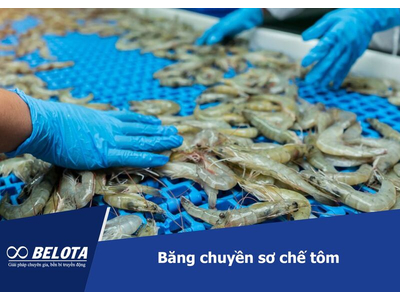
Plastic modular conveyor belts are made of interlocking plastic modules connected by hinge rods, forming a conveying surface with openings for water drainage. Their plastic construction prevents rust and offers resistance to many cleaning chemicals. They are also easy to clean, and individual modules can be replaced if damaged without replacing the entire belt.
These belts are commonly used for washing, sorting, conveying, freezing, and draining seafood products. In addition to standard surfaces, Ammeraal Beltech offers specialized belt designs with round knobs or raised patterns. These surfaces help reduce product adhesion and minimize marking or damage during conveying and freezing. Materials such as PP, PE, or POM can be selected based on load requirements, operating temperatures, and chemical compatibility.
PU Conveyor Belts
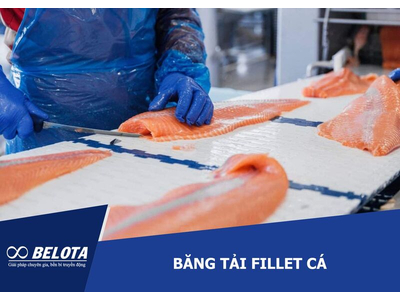
PU conveyor belts feature a smooth, low-adhesion surface that is easy to clean, making them suitable for conveying shrimp, fish fillets, squid, and other prepared seafood products. PU materials can meet food-contact requirements when the specific belt grade has the appropriate certification.
These belts are commonly installed in sorting, filleting, inspection, and packaging areas. Belota also offers sealed-edge PU belts for food processing applications. This edge treatment helps prevent water and product residues from entering the fabric carcass, improving belt durability and supporting hygiene requirements during operation.
Homogeneous PU Conveyor Belts
Homogeneous PU conveyor belts are made from solid polyurethane, with no fabric reinforcement inside. Their one-piece construction eliminates layer separation and helps reduce areas where dirt and product residues can accumulate, making them easier to clean in seafood processing environments.
These belts are suitable for direct food-contact applications, including conveying, sorting, and preparing shrimp, fish, and squid. They offer abrasion resistance, moisture resistance, and easy cleaning. Some models are also available with specially designed surfaces or structures to provide better grip for specific conveying applications.
Food-Grade PVC Conveyor Belts
Food-grade PVC conveyor belts are commonly available in white or green and are used to transport raw materials and finished seafood products during preparation, sorting, and packaging. They come in various thicknesses, surface patterns, and load capacities to suit different production line requirements.
Compared with PU, PVC belts are generally more cost-effective and available in a wider range of designs. However, the correct food-contact grade must be selected, and its resistance to low temperatures and cleaning chemicals should be checked against actual operating conditions. Belota also provides edge-sealing services for PVC belts upon request.
Stainless Steel Wire Mesh Conveyor Belts
Stainless steel wire mesh conveyor belts feature an open mesh surface in various opening sizes, allowing water, cold air, and heat to pass through the product. Their metal construction makes them suitable for applications requiring drainage, dewatering, heating, or seafood freezing.
These belts are commonly used in fish, shrimp, squid, and frozen seafood processing lines. Depending on the operating environment, Grade 304 or 316 stainless steel can be selected to meet corrosion resistance and hygiene requirements.
IQF Conveyor Belts
IQF (Individual Quick Freezing) conveyor belts are designed to transport products through quick-freezing tunnels. Depending on the freezing technology and product characteristics, three common belt types are used: stainless steel wire mesh belts, flat stainless steel belts, and plastic modular belts.
- Stainless steel wire mesh belts: Their open construction allows cold air to circulate around the products, making them suitable for individual products such as shrimp, fish, squid, and other prepared seafood.
- Flat stainless steel belts: Featuring a continuous, solid surface with no mesh openings, these belts are suitable for products that need to retain their appearance and surface quality, such as fish fillets. The smooth surface helps prevent mesh marks or imprints on products after freezing.
- Plastic modular belts: Made from interlocking plastic modules, these belts can be designed to withstand low temperatures, depending on the material grade. Available in flat or open-surface designs, they are suitable for freezing lines that require convenient drainage and cleaning.
In some IQF systems, freezing chamber temperatures can range from -38°C to -45°C. When selecting an IQF conveyor belt, check its low-temperature performance, mechanical strength, surface design, and compatibility with the conveyor's drive system.
Incline Conveyor Belts
Incline conveyor belts are used to transfer shrimp, fish, and squid from washing or soaking tanks to sorting tables and downstream processing equipment.
Depending on the product and operating conditions, these conveyors can use PU belts, modular belts, or stainless steel mesh belts. For inclined applications, the incline angle, belt speed, cleat height, and cleat spacing must be properly calculated to prevent products from sliding backward or falling off the belt.
Conveyor Belt Requirements for Each Seafood Processing Stage
|
Processing Stage |
Recommended Conveyor Belt Types |
Key Requirements |
|---|---|---|
|
Raw Material Receiving and Washing |
Plastic modular, stainless steel wire mesh, homogeneous PU |
Good drainage, abrasion resistance, and easy cleaning |
|
Preparation, Filleting, and Peeling |
PU, plastic modular, homogeneous PU |
Suitable belt surface and gentle, stable product handling |
|
Sorting and Weighing |
PU, plastic modular |
Stable operation and adjustable conveying speed |
|
IQF Freezing |
Stainless steel wire mesh, flat stainless steel, specialized plastic modular |
Low-temperature resistance and adequate airflow |
|
Packaging and Warehousing |
PU, PVC, roller conveyors, chain conveyors |
Reliable carton handling and easy cleaning |
This table provides general guidance. The final belt selection should be based on the product, equipment design, and actual operating conditions.
How to Choose the Right Conveyor Belt for Seafood Processing
To select a suitable conveyor belt, maintenance and purchasing teams should consider the following technical factors:
- Product type: Whole shrimp, fish fillets, squid, frozen seafood, or packaged products.
- Food-contact requirements: Check material documentation, hygiene requirements, and compatibility with cleaning chemicals.
- Operating temperature: Identify the minimum and maximum temperatures the belt will encounter throughout the process.
- Load and production capacity: Consider the product weight on the belt, hourly throughput, and operating speed.
- Belt dimensions and construction: Check belt width, length, thickness, surface pattern, and transfer-point spacing.
- Pulley diameter and belt tension: These affect belt tracking, service life, and overall operating stability.
- Splicing method: Choose hot vulcanizing, mechanical fastening, or another suitable joining method based on the belt material and maintenance requirements.
- Cleaning conditions: Check whether the belt can be easily removed or accessed for cleaning, including hard-to-reach areas and drainage points.
Conveyor Belt Maintenance for Longer Service Life
Conveyor belts in seafood processing plants require regular inspection because they operate in wet environments and are subject to strict hygiene requirements.
- Clean the belt surface, frame, and areas where product residues accumulate after each shift or according to the plant's sanitation procedures.
- Inspect splices, belt edges, modular links, and other areas for cracks, wear, or deformation.
- Monitor belt tension and tracking, especially after cleaning or replacing components.
- Check rollers, pulleys, bearings, and drive components for early signs of corrosion.
- For IQF conveyor belts, check belt elongation, tracking performance, and ice buildup around guide components.
A seafood processing customer shared feedback with Belota that, after a period of using sealed-edge PU conveyor belts, the belts continued to meet the plant's hygiene requirements while limiting water and product residues from penetrating the fabric carcass. Compared with homogeneous PU belts, this solution also helped reduce investment costs while meeting the production line's operating needs.
Belota - Conveyor Belt Supplier for the Seafood Processing Industry
Belota supplies a range of conveyor belts for seafood processing applications, including PU, PVC, plastic modular belts, and other specialized conveyor belt solutions.
Based on the equipment design and operating conditions, Belota provides technical support to help customers select suitable belt materials, dimensions, surface patterns, and fabrication options for each processing stage. Belts can be customized to meet specific requirements for width, length, cleats, sidewalls, guide profiles, and splicing methods.
Belota also provides sealed-edge fabrication for PU and PVC conveyor belts. This service helps protect the fabric carcass along the belt edges, reducing water and product residue penetration while improving belt durability and supporting hygiene requirements in seafood processing environments.
For conveyor belt replacement or upgrades to existing equipment, customers are encouraged to provide machine specifications, photos of the installation area, and operating conditions. This information helps Belota recommend a more suitable solution.
Frequently Asked Questions About Seafood Processing Conveyor Belts
Can PU conveyor belts be used in IQF freezing tunnels?
Yes, provided the selected belt model is designed for the operating temperature of the freezing system. Always check the manufacturer's technical specifications and confirm compatibility with the equipment.
Should I choose Grade 304 or Grade 316 stainless steel for seafood conveyor belts?
Grade 304 stainless steel is generally suitable for standard food processing environments. Grade 316 or 316L may be more appropriate for areas with frequent saltwater exposure or more corrosive conditions.
Are plastic modular conveyor belts easy to clean?
Plastic modular belts allow convenient disassembly and replacement of individual sections. However, cleaning performance also depends on the belt opening design, conveyor frame construction, installation layout, and the plant's sanitation procedures.
Conclusion
Each stage of seafood processing requires a suitable conveyor belt. Plastic modular and stainless steel mesh belts are commonly used in wet processing areas, PU belts are suitable for preparation and handling operations, while specialized belts are used in IQF freezing systems. Roller and chain conveyors can also support packaged product handling. Belota supplies a wide range of conveyor belts and provides custom fabrication services to help businesses select suitable materials, dimensions, and splicing solutions for their production lines.