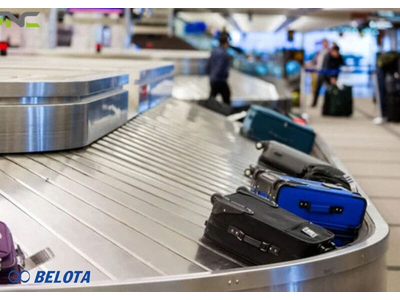
Airport conveyor belts are an essential component of baggage conveying, sorting, and handling systems. They must meet demanding requirements for durability, accuracy, and continuous operation. In high-speed sorting areas, conveyor belts need to provide high wear resistance, impact resistance, and stable performance when operating with different sorting mechanisms. Ammeraal Beltech conveyor belts, including specialized Flexam belts, are suitable options for BHS (Baggage Handling System) applications. Belota supplies, fabricates, and supports belt selection based on the actual specifications of each system.
Requirements for Conveyor Belt Systems in Baggage Sorting Areas
Conveyor belt systems in baggage sorting areas must operate continuously, accurately, and reliably to maintain a smooth flow of baggage between different stages.
- High durability: Able to handle high baggage volumes, varying loads, and continuous operating cycles.
- Precision: Maintains stable speed and tracking to ensure trays and baggage move accurately to the designated sorting positions.
- Smooth transfers: Ensures trays and baggage transfer between conveyor sections without jamming, shifting, or interruptions.
- Stable operation: The conveyor belt must be properly matched to the system's operating speed, load, pulley diameter, and overall configuration.
Core Solutions & Technical Features of Ammeraal Beltech Conveyor Belts
Ammeraal Beltech develops specialized conveyor belts for baggage sorting systems, focusing on durability, operational stability, and continuous high-speed performance.
- Strong belt construction: The belt construction and specialized coatings provide good load resistance, high wear resistance, and reliable performance under demanding operating conditions.
- Enhanced-grip surfaces: Specially designed profiles or surface patterns help keep trays stable and reduce slipping and vibration when the belt operates at high speed.
- High dimensional stability: Low belt elongation helps maintain stable dimensions and consistent performance throughout the belt's service life.
- Reduced need for re-tensioning: The belt's dimensional stability minimizes the need to stop the system for tension adjustments, helping reduce maintenance downtime and improve uptime.
- Safety requirements: Certain belt configurations are available with flame-retardant properties and can meet applicable technical safety standards for BHS applications.
- Operational and energy efficiency: Proper belt selection helps maintain stable system operation, reduce the risk of downtime, and contribute to lower energy consumption.
Conveyor Belt Applications by Baggage Sorting Technology
Depending on the system design and sorting principle, the conveyor system in baggage sorting areas can use different conveyor belts with specific constructions and surface coatings. Common baggage sorting technologies include:
Cross-Belt and Tilt-Tray Sorters
Conveyor belts are designed to transport baggage continuously at high speed while maintaining accurate positioning and routing. The belt surface must provide sufficient stability and grip to prevent baggage from slipping or shifting during transportation, particularly at transfer, diversion, and sorting points.
Tray Systems
For systems using trays to receive and sort baggage, conveyor belts can be selected with specialized surface coatings to increase grip between the belt and trays. This helps keep baggage stable during transportation while supporting smooth transfers between conveyor sections and minimizing shifting.
Pushers, Pullers & Dividers
Conveyor sections equipped with pushers, pullers, or dividers are often exposed to sudden mechanical forces. Therefore, the belt must provide high impact and shock-load resistance while maintaining durability under continuous operation. Flexam conveyor belts can be selected for applications requiring high mechanical strength and resistance to repeated impacts during baggage sorting.
Flexam Conveyor Belt Technical Specifications
One of the Flexam configurations supplied by Belota for baggage conveying and sorting systems is Flexam EX 10/2 0+05 black M2 AS FR. This is a black PVC conveyor belt with antistatic and flame-retardant properties, while the underside is designed to help reduce operating noise.
Key specifications of this configuration include:
| Technical Specification | Value |
|---|---|
| Material | PVC |
| Belt thickness | 2.50 mm |
| Weight | 2.90 kg/m² |
| Tensile force at 1% elongation | 10.0 N/mm |
| Operating temperature | -15 to 80 °C |
| Minimum pulley diameter – flexing in one direction | 60 mm |
| Minimum pulley diameter – reverse flexing | 80 mm |
| Standard belt width | 1,000 mm |
| Maximum belt width | 3,000 mm |
| Support type | Slider bed, rollers, or flat support |
Belota Supplies and Fabricates Flexam Conveyor Belts for Airport Applications
Belota supplies and fabricates Ammeraal Beltech conveyor belts for baggage conveying, sorting, and handling systems in airport applications. For Flexam belts, Belota supports belt selection based on the actual equipment specifications and then fabricates the belt to the required dimensions.
Available services include:
- Belt selection consultation: Reviewing machine specifications, load, operating speed, pulley diameter, and support type.
- Custom fabrication: Cutting, dimensional processing, and belt joining according to application requirements.
- Replacement of existing belts: Checking the specifications of the current belt to identify a suitable replacement configuration.
- Technical support: Providing guidance on belt joining methods, installation, and other requirements related to operation.
Conclusion
Selecting the right conveyor belt for baggage sorting systems directly affects the stability, throughput, and operating uptime of the entire BHS. Factors such as load, belt speed, pulley diameter, support type, wear resistance, impact resistance, and safety requirements should be evaluated together. With Ammeraal Beltech Flexam conveyor belts, Belota can support customers with belt configuration selection, custom fabrication, and replacement based on the actual machine specifications. When selecting a conveyor belt for an airport baggage handling system, customers should provide the belt model, dimensions, operating speed, and equipment specifications so the appropriate configuration can be recommended.