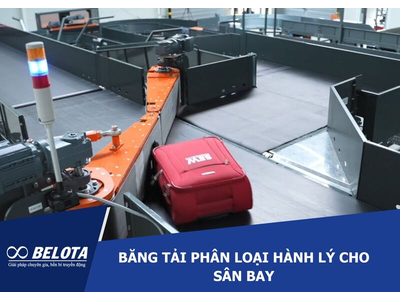
The airport baggage handling system is a critical link that directly impacts operational efficiency, passenger experience, and an airline's reputation. A logically designed system is vital to mitigating risks such as lost luggage, technical glitches, and ballooning operational costs. In this guide, Belota provides a practical, plain-English overview to help you make the right investment from day one.
What is an Airport Baggage Conveyor System?
An airport baggage conveyor is a specialized system designed to transport, sort, and deliver luggage throughout the terminal. Built with high-durability conveyor belts, the system ensures a seamless flow of bags from check-in counters through security screening, into sorting facilities, and finally to the baggage claim area at the arrivals gate.
In modern aviation logistics, these systems are more than just mechanical belts; they function as the “nervous system” of the terminal. A precision-engineered conveyor setup helps prevent bottlenecks, minimizes mishandled baggage, and maintains smooth passenger throughput, especially during peak travel periods.
Common Types of Baggage Conveyors
Straight Conveyors
- The Setup: A simple point-to-point design (from Point A to Point B).
- Usage: Common at check-in counters and back-of-house transfer zones.
- Pros: Low capital expenditure (CapEx), easy installation, and straightforward maintenance.
- Cons: Lacks flexibility in tight or complex floor plans.
Curved Conveyors
- The Setup: Designed to change directions based on the terminal’s layout.
- Usage: Connecting different baggage processing zones.
- Pros: Excellent space optimization and flexible routing.
- Cons: Higher cost than straight belts; requires high-precision engineering to prevent bag jams.
Oval / Carousel Systems
- The Setup: A continuous closed-loop design where luggage circulates.
- Usage: Standard for Arrivals Baggage Claim.
- Pros: Allows multiple passengers to spot and retrieve bags simultaneously, reducing crowding.
- Cons: Requires a significant footprint for installation.
Baggage Claim Carousel Systems
- The Setup: A specialized assembly typically combining curved and oval sections.
- Pros: Optimized for the "last mile" of the passenger journey; speeds up retrieval.
- Cons: High investment cost; requires seamless integration with the wider Baggage Handling System (BHS).
Deployment by Airport Scale
| Airport Size | Recommended System | Primary Benefit |
| Regional / Small | Straight Conveyors | Low cost, fast setup, easy DIY maintenance. |
| Medium / Domestic | Straight + Curved Mix | Space optimization and zone connectivity. |
| Major / International | Specialized Carousels & BHS | High throughput, reduced congestion, premium CX. |
Strategic Placement & Conveyor Roles
- Check-in Zone: Straight or curved belts that feed bags into the central processing system.
- Sorting Area (BHS): High-speed or automated sorting belts that ensure bags reach the correct flight.
- Security Screening: Specialized roller conveyors integrated with X-ray scanners.
- Baggage Claim: Oval or carousel units for passenger retrieval.
- Transfer & Back-of-House: Heavy-duty straight belts designed for 24/7 continuous hauling.
Advanced Solutions: Floor & Robotic Systems
Floor Conveyors
Commonly used within the Baggage Handling System (BHS) to link various lines. They are highly customizable based on the terminal's floor plan and can handle heavy loads at varying speeds.
Robotic Conveyor Systems
The "next-gen" upgrade. These integrate with ASRS (Automated Storage and Retrieval Systems). Using scanners, cameras, and RFID coding, these systems sort bags with pinpoint accuracy, drastically reducing manual labor and human error.
Technical Benchmarks for Selection
- Load Capacity & Throughput: The system must handle "surge" loads during peak hours without belt sagging or motor burnout.
- Velocity & Stability: Speed must be consistent, fast enough for efficiency but smooth enough to prevent bags from sliding or toppling.
- Mechanical Rigidity: Frames must be vibration-resistant. We prioritize corrosion-resistant materials for long-term durability in high-traffic public areas.
- Acoustics & Safety: Low-noise operation is essential for passenger comfort. Safety features must include accessible emergency stops and "no-pinch" surfaces to protect fingers and luggage wheels.
- Scalability: The design should allow for modular "bolt-on" expansions as passenger volume grows.
The Belota Advantage: Why Partner With Us?
Investing in a baggage system isn't just about buying hardware; it's about securing a reliable operation. Belota delivers end-to-end expertise:
- Expert Consultation: We evaluate your floor plan and traffic flow to recommend the most cost-effective setup.
- Aviation-Grade Engineering: Our systems meet strict standards for load, speed, and safety.
- Turnkey Installation: From fabrication to on-site commissioning, we ensure minimal downtime.
- Lifecycle Support: We provide scheduled maintenance and rapid-response troubleshooting to keep your terminal running 24/7.
Looking to streamline your terminal logistics?
Contact Belota today for a professional consultation and custom system design.
📞 Hotline: 0917.657.946
The Bottom Line: A baggage system is a long-term play. Doing it right the first time reduces complaints, lowers maintenance costs, and cements your airport's reputation for efficiency. Partner with an expert who understands the stakes.